




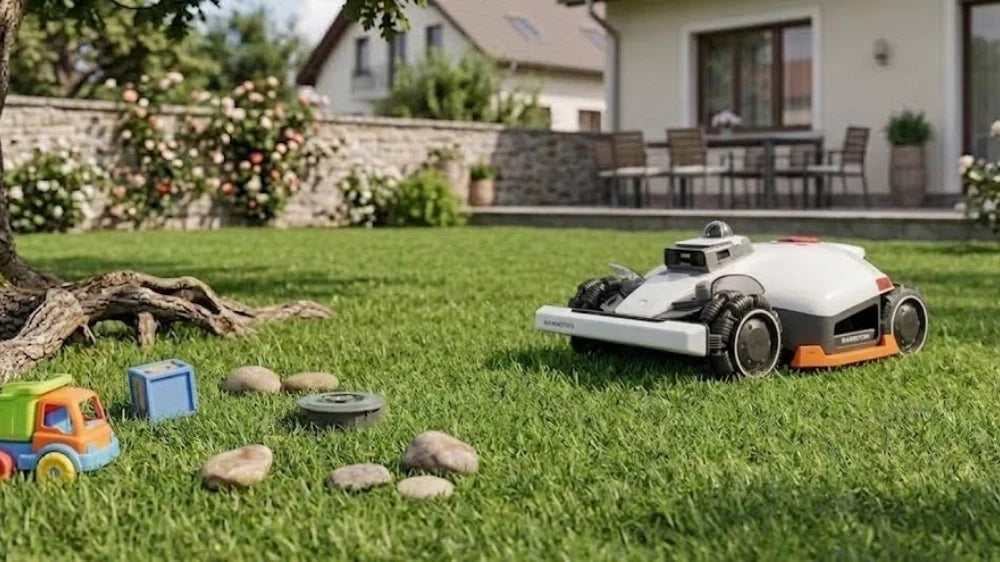
Robot lawn mower obstacle avoidance can help with objects on the lawn, but a robot lawn mower does not see your garden as you do. Long grass can obscure a stone or root, while a fully buried object may offer no useful surface detail for its sensors. Camera resolution and AI processing alone cannot remove these limits. This guide explains what to check in your garden before mowing, and how to manage hazards once the robot lawn mower is installed.
Why check the lawn before mowing?
A lawn that looks level can still contain stones, roots and sprinkler heads that affect a robot lawn mower. Missing them during preparation can lead to several kinds of cost:
| Type of cost | Possible consequences |
|---|---|
| Repairs and replacement parts | Wear or damage to components, followed by replacement costs |
| Day-to-day operation | Interrupted mowing, getting stuck and manual intervention |
| Property and safety | Damage to the lawn or objects thrown towards nearby people or property |
When using a conventional lawn mower, you can change your viewing angle and draw on your knowledge of the garden. A robot relies on the information available to its sensors. Cameras capture light from the scene, while LiDAR uses laser returns and ultrasound uses sound echoes. Grass or soil can obscure the surfaces these systems need to detect.
Which obstacles can a robot lawn mower detect?
Whether an object is exposed, partly obscured or fully concealed makes a difference. Its size, shape and surroundings matter alongside the robot lawn mower's sensor system.
| Obstacle type | Examples | Detection challenge | Practical action |
|---|---|---|---|
| Clearly visible | Tree trunks, furniture and exposed toys | An exposed outline helps, but detection is not guaranteed | Remove loose items; assess fixed features |
| Partly hidden or low contrast | A stone in long grass or an object in shade | The object may be visible without being recognised | Inspect and remove it, or exclude a known fixed hazard |
| Fully concealed or buried | A buried fitting or a root covered by dense grass | No exposed surface may be available to standard sensors | Check whether it could be contacted; address or exclude the hazard |
Clearly visible obstacles
Garden furniture, a tree trunk, a passing animal, a toy or a stone on the surface may be easier to detect when their outline stands out from the grass. Cameras and distance sensors can help, but visibility does not guarantee that every object will be recognised or avoided. Small objects and moving animals still need particular care.
Partly hidden or difficult-to-recognise obstacles
A stone with just one corner showing through long grass, a low-contrast object in shade or strong backlighting, or a small item among dense vegetation may appear in the camera image without being recognised correctly. Camera positioning, additional viewpoints and improved image processing can help, but performance still depends on the object and the conditions. A newer model is not, by itself, proof of better detection in your garden.
Fully concealed or buried objects
A buried sprinkler head, a stone beneath the soil or a root completely covered by dense grass may not present an exposed surface that the robot lawn mower can recognise. This is different from an object that is visible but misidentified. Do not rely on a robot lawn mower's standard obstacle sensors to detect through soil or fully concealing vegetation.
A stone completely below the soil surface will not be struck simply because the robot lawn mower passes over that patch. The risk changes if soil settles or erodes and exposes part of the stone, or if a root or sprinkler head sticks up through the grass. The robot lawn mower may then contact the exposed part even when grass hides it from the sensors. Check for hard or sharp features that the wheels, underside or blades could reach.
A garden checklist before mowing
Inspecting the lawn helps you assess the conditions a robot lawn mower will actually face. It is part of choosing a robot lawn mower for your garden, rather than a substitute for comparing specifications.
Step 1: walk the lawn and mark potential hazards
Look for a root near the surface, a protruding stone, a sprinkler head standing a few millimetres above the ground, or an unusually dense patch of grass that may hide something. Compare protrusions with the obstacle-crossing specification for the model you are considering.
Height is only one part of the check. A sharp stone or hard sprinkler fitting can remain a concern even below the stated crossing limit. That limit should not be treated as permission to drive over every object of that height.
Step 2: separate removable objects from fixed features
Loose gravel and other movable items can be cleared away. Roots and irrigation fittings may need a different approach. Pay particular attention to fixed features that are partly hidden or may become exposed as grass and ground conditions change.
Step 3: decide what to remove or exclude
Remove loose objects before mowing. For fixed features, assess whether the robot lawn mower can approach them safely under the model's operating instructions. Where a known hazard is difficult to recognise, or should not be approached, mark a no-go zone in the app rather than relying only on detection each time.
Use this checklist to record your inspection:
| Check | Done |
|---|---|
| Assess the general level and condition of the lawn | ☐ |
| Locate sprinkler heads, including fittings currently below the surface | ☐ |
| Identify exposed roots and roots close to the surface | ☐ |
| Find gravel and stones, including those hidden by dense grass or sharp-edged pieces below the crossing limit | ☐ |
The Evolution of Obstacle Avoidance in Robot Lawn Mowers
Robot lawn mowers have moved from relying mainly on physical contact towards systems that can recognise some obstacles before contact. Improved cameras and combinations of sensors can help with partly obscured objects, although they do not remove the need to prepare the lawn.
Boundary-wire installations and their limits
A traditional installation may use loops of boundary wire to exclude fixed obstacles. The layout takes planning and can need adjustment when the garden changes. Some basic models rely on a bumper to react to objects that have not been excluded. However, using boundary wire does not by itself tell you which obstacle sensors a robot lawn mower has.
Wire-free navigation and sensor-based detection
A robot lawn mower without perimeter wire uses a different way of defining its working area. Obstacle detection is a related but separate function, and the systems below should not be read as a fixed sequence shared by every manufacturer:
- Contact detection: a bumper reacts after contact. It can help with suitable solid obstacles, but is not a reliable way to manage low, sharp or hidden objects.
- Cameras and distance sensors: cameras use light from the scene; ultrasound uses sound, radar uses radio waves and LiDAR uses laser light. Their performance depends on the sensing method, viewing angle, object and surroundings. Partial concealment can make detection harder; these are not ground-penetrating sensors.
- AI vision and sensor fusion: vision can help classify objects while distance sensors help measure their position relative to the robot lawn mower. RTK improves the robot lawn mower's position on the map; it does not directly identify a stone or root. Combining these inputs can support navigation and avoidance.
When comparing models, look at the actual sensor combination and its stated limitations, rather than assuming that a wire-free design or a newer release will detect every obstacle.
How do Mammotion robot lawn mowers handle complex obstacles?
Three functions play different roles: navigation and object recognition help the robot lawn mower respond to exposed obstacles; terrain-crossing ability helps it negotiate suitable changes in level; and no-go zones let you exclude known fixed hazards. None should be treated as a replacement for the others.
Tri-Fusion positioning: LiDAR, NetRTK and AI vision
On LUBA 3 AWD 3000 and 5000, Tri-Fusion positioning combines 360° LiDAR, NetRTK and dual-camera AI vision. LUBA 3 AWD 1500 uses LiDAR and AI vision. The sensor combination therefore needs to be checked for the specific model.
Using more than one source of positioning information can reduce dependence on a single method, for example when satellite reception weakens near a tree. It does not guarantee that two systems are always available or that mowing can continue in every situation.
Intelligent object recognition
LUBA 3 AWD is specified to recognise more than 300 types of obstacle, including animals, toys and garden features. This is a range of recognised categories, not a promise that every instance will be detected in every light level or degree of concealment.
Obstacle-crossing ability is not obstacle detection
Mammotion's UK launch information lists obstacle-crossing ability of up to 50 mm for the LUBA 3 AWD series. This concerns the terrain the robot lawn mower can negotiate under suitable conditions. It is different from recognising an object and steering around it, and does not guarantee damage-free contact with an unseen object.
A sharp piece of gravel can still damage a blade or scratch the chassis even if it is below that height. A low, rounded change in ground level and a sharp stone are not equivalent simply because they measure the same height.
No-go zones for hazards the robot lawn mower should avoid
A no-go zone tells the robot lawn mower to keep out of a mapped area. It reduces reliance on recognising the same hazard during every pass, but the robot lawn mower still needs suitable positioning and a correctly configured boundary. Useful examples include:
- Low flower beds and planting that is difficult to distinguish from grass.
- Pond or swimming-pool edges without a clearly defined physical boundary.
- Glass doors and fine mesh screens: transparent or thin materials can be difficult for cameras and LiDAR to interpret reliably.
- Thin, low objects such as tent guy lines, low-hanging washing lines and hosepipes.
- Kennels or animal shelters.
- Valuable or delicate plants, including crops and ornamental planting.
Exclusion is useful both for hard-to-detect objects and for visible areas you want the robot lawn mower to leave alone. For another example involving low, awkward shapes, see our guide to robot lawn mowers around trampolines and swings.
Lift and tilt detection provide additional safety measures on compatible models. They are designed to stop the cutting system when the relevant conditions are detected, rather than make all contact or lifting situations risk-free.
FAQ
Can lawn care change which obstacles are hidden?
Yes. Changes in soil level, including settlement or erosion, can expose a sprinkler fitting, root or stone. Dense grass growth can conceal something that was previously visible. Recheck known trouble spots as conditions change, rather than treating the pre-purchase inspection as a one-off task.
Should I check the garden before each mow?
Make a routine check for loose objects before mowing, following your model's instructions. Remove toys, fallen branches and stones rather than assuming the robot lawn mower will avoid them. A known no-go zone does not account for new objects left elsewhere on the lawn.
A more thorough check is particularly useful after heavy rain, ground settlement, dense seasonal growth or gardening work, when previously hidden features may become exposed or new hazards may appear.
What can happen if the robot lawn mower misses an obstacle?
Depending on the object, contact may cause blade wear or damage, scratch the chassis, interrupt mowing or leave the robot lawn mower stuck. Stones can also be thrown, as noted in the risk table above.
Use lawn checks, removal of loose objects and exclusion of known fixed hazards alongside onboard detection. Improved recognition reduces some risks; it does not remove them all.
Can a robot lawn mower detect stones and roots under long grass?
Sometimes, if enough of the object is exposed for its sensors to recognise it. Partial cover, low contrast and the object's shape can make detection harder. Do not rely on standard obstacle avoidance for a feature fully hidden by grass or soil; inspect it and decide whether to remove it or exclude the area.
Does setting a no-go zone replace obstacle detection?
No. A no-go zone helps the robot lawn mower avoid a known mapped location. Object detection helps it respond to things it encounters elsewhere. The boundary still needs to be mapped correctly, and loose or newly introduced objects still need attention.
Conclusion
When comparing robot lawn mowers, look at sensor capabilities alongside the actual hazards in your garden. Obstacle recognition, terrain-crossing ability and no-go zones serve different purposes.
Walk the lawn before mowing, remove movable hazards and plan exclusions for fixed features that should not be approached. Keep checking as the garden changes. These steps help the robot lawn mower work more reliably without asking its sensors to detect what is hidden from them.

Did you like this article? Add us as a preferred source to find us more easily on Google.