







Watching the 2026 World Cup matches on the telly, you've probably found yourself wondering. That hypnotic green, those lines of almost surgical straightness, not a single weed in sight. So — is it the real thing, or clever trickery?
And the timing couldn't be better: we're now into the closing stretch of the grand final is just around the corner, and within a matter of days we'll finally know who lifts the trophy. The perfect moment to unpick the secrets of this legendary pitch together — and to see how today's maintenance technology lets you turn your own garden into a truly prestigious playing surface.
Part 1. The great green con: is the pitch for this summer's big 2026 matches actually real grass?
It's the topic that fuels every post-match chat this summer. After all, plenty of leagues and international competitions have caved in to artificial turf over the past few decades, purely for the sake of convenience. So why not do the same for the 2026 World Cup?
Let's settle the question once and for all: the international governing bodies flatly ban 100% synthetic pitches for the knockout stages of the World Cup. The reason? Player welfare. Plastic dramatically increases the risk of joint injuries (knee twists in particular) and causes nasty burns during sliding tackles.
What you're seeing on screen is, in fact, a hybrid pitch. The secret behind this marvel lies in a jeweller's-precision blend:
- 95% natural grass (chosen from the most hard-wearing varieties).
- 5% micro-synthetic fibres injected deep down (up to 18 cm into the soil) to stabilise and lock in the roots.
The figure that makes your head spin: according to the organising committees' reports, preparing and pampering the natural and hybrid pitches for an event like the 2026 World Cup often runs to a budget of well over a million euros per stadium. A colossal investment to achieve density and resistance to foot traffic that are simply out of the ordinary.
Part 2. The science: why does the pitch have two-tone stripes?
That hypnotic visual effect comes down to the way the blades of grass are angled as the mower passes over them. Professional machines are fitted with a heavy roller at the back that lays the grass down in the direction of travel.
- The light stripe: the mower has moved away from you. The grass leans forward, sunlight reflects off the whole flat surface of the blade, and that's what creates the bright, glossy look.
- The dark stripe: the machine has come back towards you. The grass is laid down in your direction. You're now looking at the tips of the blades and the shaded areas beneath them, which absorb the light.
It's this perfect contrast that gives the impression of perfection. But for this optical trick to work — rather than descend into a greenish mess — there's one non-negotiable condition: absolute consistency of cut.
For the stripes to look crisp and the ball to run smoothly, the international rules impose a cutting height of military strictness: between 24 mm and 28 mm, with a tolerance of less than 2 mm variation across the entire pitch.
| Pitch parameter | Pro-stadium standard (FIFA requirement) | Direct impact on finish and play |
|---|---|---|
| Cutting height | 24 mm to 28 mm | The ideal height for optimal light reflection without weakening the plant. |
| Height consistency | Variation < 2 mm across the pitch | Guarantees perfectly even stripes and prevents false bounces. |
| Stripe width | Strictly 5.5 metres | A visual reference for officiating and perfect geometric alignment. |
To keep to this standard, the pitches are mown up to twice a day. Why so often? Because if the grass grows by even 3 millimetres, the blade straightens up, loses its lean, and the visual effect of the two-tone stripes fades away in an instant.
Part 3. The reality: why does your ordinary mower fall short?
1. The geometric impossibility of marking out by eye
To achieve the World Cup's two-tone effect, the stripes have to be perfectly parallel. The trouble is: the human eye loses its sense of parallelism after barely 5 metres of pushing a 30 kg vibrating machine. Without centimetre-level guidance, every tiny deviation in your path instantly breaks the reflection of the light.
2. The scalping phenomenon on uneven ground
Stadiums are levelled to the millimetre. In an ordinary garden, the ground has micro-contours (bumps, dips, roots). A traditional mower — with its rigid chassis and manual adjustment — copes very poorly with these variations.
Yet the optical play of the stripes demands strict height consistency (< 2 mm variation). The classic 5- or 6-notch levers are hopelessly short on precision for this kind of result.
3. The one-third rule and the collection trap
To achieve that "carpet-like" density, the professionals' secret is to mow very often (sometimes daily), trimming away barely 1 or 2 mm each time. This is the technique of invisible mulching, which fertilises the soil continuously. With a traditional mower, keeping up this frequency day in, day out is simply unrealistic.
Part 4. The solution: Mammotion, or the art of bringing the big-stadium standard home
1. The end of cables and the perfection of lines
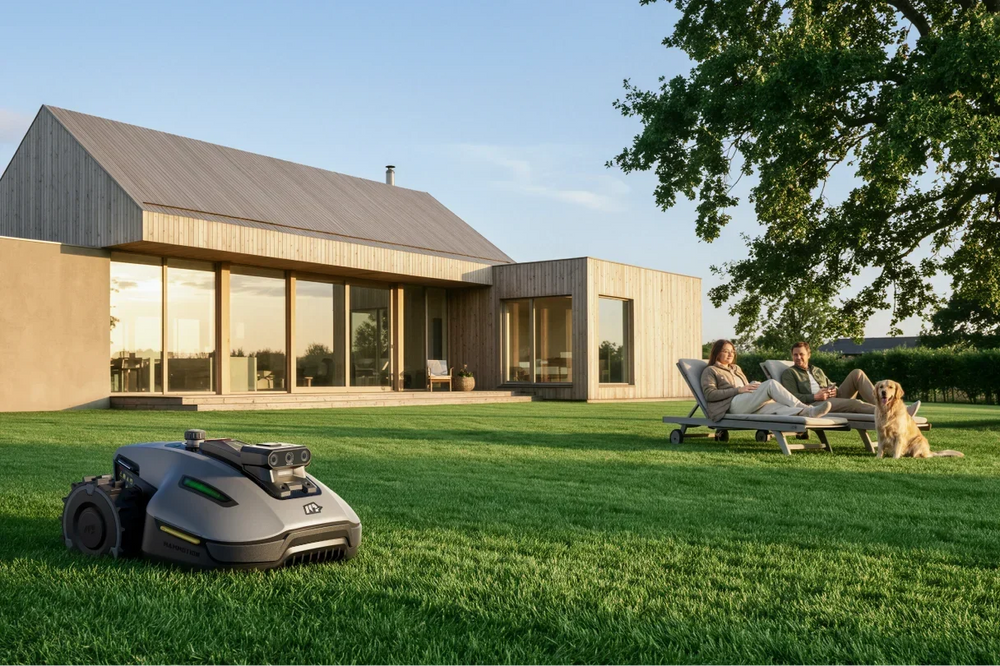
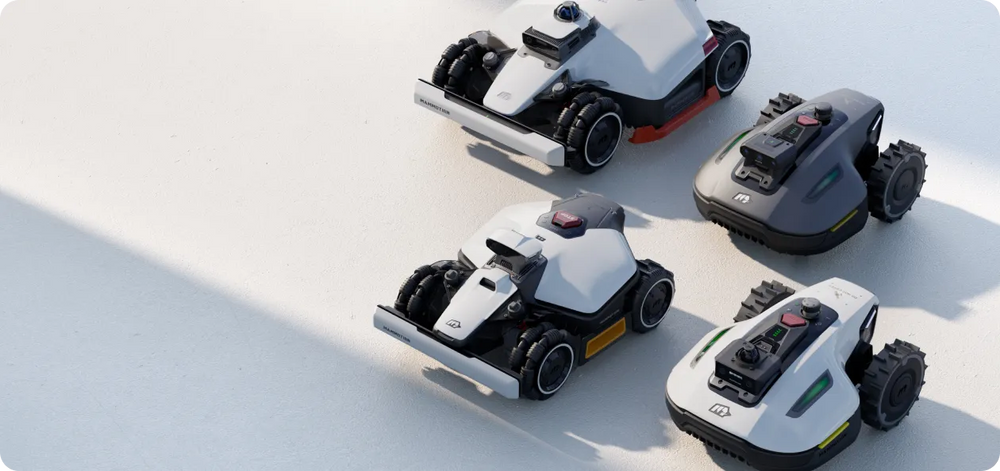
To trace dead-straight parallels without drifting so much as a millimetre, you don't need a surveyor's line — you need spatial precision. Where first-generation robots navigate at random and force you to lay a tedious perimeter cable, Mammotion draws on RTK technology combined with satellites.
- Zero cables: the mapping is done virtually via the smartphone app in just a few minutes.
- Centimetre precision: the robot knows its position in real time to within 1 cm.
- Algorithmic path: it works its way across the lawn systematically, executing perfectly parallel lines. It's this mathematical consistency in the direction of travel that lets it angle the blades of grass evenly — recreating, in your own garden, the optical effect of the big stadiums' two-tone stripes.
2. Electronic adjustment to the millimetre: direct access to the regulation 26 mm
As we've seen, the secret to dense grass lies in respecting the one-third rule and keeping a constant height. Mammotion cracks the equation with fully automated cut management:
- Digital height adjustment: no more imprecise mechanical levers. From the app, you set the cutting height to the millimetre — 26 mm, for example (right at the heart of professional standards).
- High-frequency robotic mowing: by mowing autonomously several times a week, the robot only trims 1 to 2 mm on each pass.
- Precision invisible mulching: the tiny clippings fall straight back between the blades to feed the soil, doing away for good with the chore of emptying the grass box.
By eliminating human errors of trajectory and automating frequent micro-cutting, Mammotion technology turns the upkeep of a residential lawn into a professional-grade process.
Part 5. Total personalisation for the 2026 season of big matches: Mammotion's 3D graphic mowing
If tracing the regulation two-tone stripes is child's play for the Mammotion robot mower's algorithms, the brand goes further still — turning your lawn into a genuine canvas for self-expression. Thanks to the exclusive 3D graphic mowing feature, the robot no longer merely maintains: it designs.
By dynamically varying the height of its cutting discs and the orientation of its paths to within a centimetre, the Mammotion robot mower can "draw" complex patterns directly onto the grass, visible from your terrace or your windows.
Through the Mammotion robot mower app, you can pick from a library of pre-programmed patterns or give free rein to your creativity. While the nations battle it out on the pitch, you can show off your allegiances right there on your lawn:
- Sporting motifs: draw a perfect football, rings or stars in the middle of your garden.
- Lettering and numbers: the system supports all 26 letters of the alphabet and the 10 digits. So you can spell out your favourite player's name, the score of a legendary match, or your team's name.
- Geometric and artistic shapes: hearts, circles, constellations, fir trees, or custom shapes in DIY mode.
No more toxic marking paint or fiddly stencils. The robot handles the topography of the design in a purely mechanical, plant-based way. It's the ultimate premium selling point for turning your outdoor space into something unique and thoroughly personalised — and it's bound to get your guests talking on match nights this summer.
Conclusion
The 2026 World Cup proves to us that visual perfection is no longer a question of manpower, but of high technology. That two-tone, ultra-dense green carpet that has millions of viewers dreaming is no longer the exclusive preserve of international stadiums or pharaonic budgets.
And now, with the final on the doorstep and the champion about to be decided, there's no better moment to take the plunge. By bringing the spatial precision of RTK guidance and the flexibility of automated mowing into the heart of your garden, the Mammotion robot mower is rewriting the rules of outdoor upkeep. You no longer have to choose between sacrificing your weekends and gazing at an imperfect lawn.
This summer, settle in comfortably, enjoy the spectacle of the competition, and let technology make your back garden the finest pitch in the neighbourhood. It's time to give your property the prestige it deserves.
Disclaimer: This article refers to the 2026 World Cup and the world of football for purely illustrative and technological purposes. Mammotion has no official affiliation, no commercial partnership, and no sponsorship agreement with FIFA, the national teams, the organising committees or the professional players.
Did you like this article? Add us as a preferred source to find us more easily on Google.