




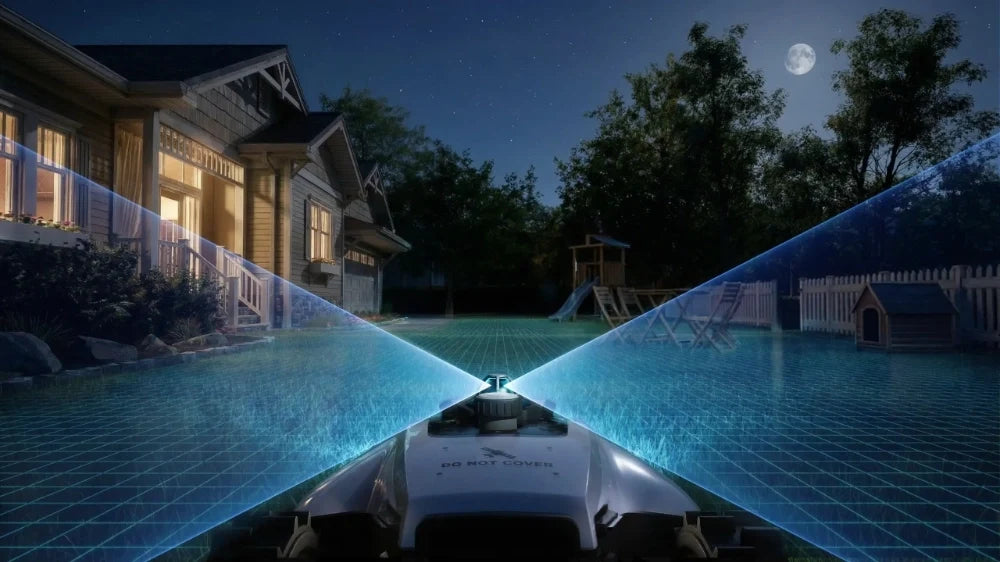
Trees blocking satellite signals, flower beds to work around and a narrow passage between lawns: in a complex garden, a conventional robot lawn mower can quickly lose its bearings or stop mid-mow. A LiDAR robot lawn mower offers a practical way to tackle these challenges without perimeter wire. Its laser sensors scan the surroundings in real time to map the garden and plan its routes. Here is how the technology works, its main advantages and the gardens where it makes a real difference.
1. How does a LiDAR robot lawn mower work?
LiDAR stands for Light Detection and Ranging. The sensor sends out laser pulses and measures how long they take to return after reflecting off features such as walls, trees and hedges. This allows it to calculate distances.
Combined with SLAM—simultaneous localisation and mapping—these measurements help the robotic lawn mower build a map, work out its position within it and plan its mowing routes.
Unlike a camera-only system, laser ranging does not depend on daylight. It is therefore useful in shade or low light, while a camera can help recognise the objects detected.
Some models combine LiDAR and vision without using RTK. Others add NetRTK, receiving satellite-positioning corrections over a network without a separate RTK reference station in the garden.
2. Benefits and Drawbacks of LiDAR Robotic Lawnmowers
LiDAR provides a detailed picture of the surroundings, even as light levels change. Purchase cost and the sensor’s limitations in bad weather are also worth considering.
Advantages:
- Distance measurements without daylight: laser ranging works in sunshine, shade and darkness.
- Detailed mapping: LiDAR measures the position of nearby features to help the robotic lawn mower navigate narrow passages and irregular lawn edges.
- A useful fit for complex gardens: trees, walls and other fixed features provide references for local navigation, alongside the model’s other sensors.
- No perimeter wire to bury: as with other navigation systems without perimeter wire, mowing areas and virtual boundaries are set in the app.
Limitations:
- A purchase budget to plan for: allow around €1,000–€5,000 for a LiDAR robotic lawn mower, with entry-level models at around €1,000. Rated lawn area, drive system, cutting equipment and navigation features account for some of the price differences.
- Sensitivity to dense fog and heavy rain: these conditions can scatter or weaken laser signals. Vision or RTK can provide additional information, but do not remove the effects of poor weather.
3. Which Gardens Benefit Most from a LiDAR Robot Lawn Mower?
A LiDAR robot lawn mower is particularly useful where trees, walls and garden features make navigation more complicated. Local mapping helps it locate these features and plan its routes. To choose the right robotic lawn mower, start with the following garden layouts:
- Tree-lined or shaded gardens: LiDAR measures distances around trunks, hedges and walls without relying on daylight. It is especially useful where vegetation or buildings interfere with satellite reception.
- Irregularly shaped lawns or narrow passages: measuring the space around the robotic lawn mower helps it navigate beside flower beds, paths and boundaries that change direction.
- Gardens with several mowing zones: LiDAR mapping helps the robotic lawn mower find its way along routes between lawns and around obstacles. It works alongside the model’s multi-zone management and suitable connecting routes.
- Large gardens with open and tree-covered areas: LiDAR provides local references in the more complex sections. Paired with RTK or NetRTK, it can also use satellite positioning across large, open areas where surrounding reference features are fewer.
| Your garden | What LiDAR contributes | A useful supporting feature |
|---|---|---|
| Trees, shade and nearby walls | Positioning from garden features, even in low light | Vision to help recognise objects |
| Irregular shapes, passages and separate lawns | Mapping spaces and obstacles along the route | Multi-zone management and suitable connections |
| A large garden with open and tree-covered areas | Local references in complex sections | RTK or NetRTK across large, open areas |
4. Which Mammotion robotic lawn mowers have LiDAR?

The five Mammotion robotic lawn mower models below use LiDAR, with different configurations to suit the lawn area and terrain.
YUKA mini 2 1000
The YUKA mini 2 1000 combines 360° LiDAR with dual-camera AI vision for lawns of 1,000 m². Its sensor has a 360° × 45° field of view and a detection range of 60 m. This rear-wheel-drive model manages up to 10 zones and slopes of up to 45% (24°).
LUBA mini 2 AWD 1500
The LUBA mini 2 AWD 1500 combines 360° LiDAR and dual-camera AI vision to map the garden and navigate around trees, obstacles and narrow passages. Its LiDAR sensor has a protective alloy cover designed to resist impacts without obstructing detection. All-wheel drive suits more uneven gardens, with a maximum slope capability of 80% (38.6°).
LUBA 3 AWD 1500
The LUBA 3 AWD 1500 pairs 360° LiDAR with dual-camera AI vision for lawns of 1,500 m². Unlike the 3000 and 5000 versions, it does not use RTK or NetRTK. This configuration uses garden features for local navigation, including beneath trees and in low light.
LUBA 3 AWD 3000 and 5000
Developed by Mammotion Atlas Lab, Tri-Fusion combines 360° LiDAR, NetRTK and dual-camera AI vision. It is the world’s first Tri-Fusion positioning system. The LiDAR has a 360° × 59° field of view and a maximum detection range of 70 m. Vision helps recognise objects, while NetRTK through Mammotion iNavi Service provides satellite-positioning corrections over a network, without a separate RTK station in the garden.
The system provides ±1 cm positioning accuracy with intelligent switching between sensors. The 3000 and 5000 share this navigation configuration and are rated for lawns of 3,000 m² and 5,000 m² respectively.
| Model | Position in the range | Navigation | Advantages | Suitable terrain | Maximum zones | Maximum slope | Drive |
|---|---|---|---|---|---|---|---|
| YUKA mini 2 1000 | For 1,000 m² gardens | 360° LiDAR + dual-camera AI vision | LiDAR mapping and vision, without an RTK base station | Lawns with trees, corners or passages | 10 | 45% (24°) | RWD |
| LUBA mini 2 AWD 1500 | For complex 1,500 m² gardens | 360° LiDAR + dual-camera AI vision | Local navigation and protection for the LiDAR sensor | Sloping gardens with trees or narrow passages | 20 | 80% (38.6°) | AWD |
| LUBA 3 AWD 1500 | For demanding 1,500 m² gardens | 360° LiDAR + dual-camera AI vision; no RTK/NetRTK | LiDAR and vision positioning | Complex, shaded or sloping gardens | 15 | 80% (38.6°) | AWD |
| LUBA 3 AWD 3000 | For 3,000 m² lawns | 360° LiDAR + NetRTK + dual-camera AI vision | Tri-Fusion with intelligent sensor switching | Large gardens combining open areas, trees and slopes | 30 | 80% (38.6°) | AWD |
| LUBA 3 AWD 5000 | For 5,000 m² lawns | 360° LiDAR + NetRTK + dual-camera AI vision | Tri-Fusion for a larger rated lawn area | Very large gardens with varied layouts | 50 | 80% (38.6°) | AWD |
5. How to Choose a LiDAR Robot Lawn Mower?
When choosing a robot lawn mower with radar or LiDAR, first check whether it uses LiDAR or millimetre-wave radar, and whether the technology is primarily used for mapping and navigation or obstacle detection. Then compare the specifications against the conditions in your garden. Consider the following factors in order of priority:
Lawn area and number of mowing zones
Choose a model with a coverage capacity suited to the actual area you need to mow. If your lawn is split between several areas, such as front and back gardens, check how many mowing zones it supports and the access requirements between them.
Garden layout and navigation system
In gardens with extensive tree or building cover, numerous passages or closely spaced obstacles, pay particular attention to the mower’s ability to map its surroundings and maintain its position. If it also uses RTK or NetRTK, check satellite signal reception and any associated service requirements. Being equipped with radar or LiDAR alone does not establish whether a mower is suitable.
Slope capability and ability to handle uneven ground
For sloping or noticeably uneven gardens, prioritise the drive system, maximum working gradient and traction. Radar or LiDAR helps the mower perceive its surroundings, while its ability to climb slopes and negotiate difficult ground still depends on the overall machine design.
Sensor coverage and real-world detection performance
Compare the sensor’s horizontal and vertical field of view, effective detection range, close-range blind spots and measurement accuracy. A longer advertised range or wider scanning coverage does not necessarily mean better mowing results. What matters more is whether the mower can consistently maintain its position in your garden and detect obstacles in its path.
Obstacle avoidance and coordination between sensors
Check whether LiDAR works alongside cameras, bump sensors or other sensors, and review its limitations when detecting low, small or overhanging obstacles. If your garden contains toys, exposed tree roots or garden furniture supports, its ability to recognise those specific obstacles is more useful than the sensor count alone.
Installation, maintenance and running costs
Finally, check the mapping process, charging station placement, no-go zone settings, sensor cleaning requirements and any connectivity or subscription charges. Also consider edge-cutting performance and after-sales support to assess how much manual intervention will be needed.
FAQ
What is the best LiDAR robot lawn mower?
The right choice depends on lawn area, layout, slopes and budget. For medium-sized gardens, the LUBA mini 2 AWD 1500 and LUBA 3 AWD 1500 combine LiDAR and dual cameras. For larger lawns, the LUBA 3 AWD 3000 and 5000 add NetRTK and offer different rated coverage.
Does LiDAR work in rain or fog?
LiDAR can work in light rain. Dense fog or heavy rainfall can scatter or weaken laser signals. Other sensors can support navigation, but do not make the system unaffected by bad weather.
What is the difference between LiDAR and a camera?
LiDAR measures distances using lasers without relying on daylight. A camera captures images that an AI algorithm analyses to recognise objects. The two technologies are often combined for navigation and obstacle recognition.
Does LiDAR work at night?
Yes. Laser-pulse measurements do not need daylight, so LiDAR can continue measuring distances in darkness.
Does LiDAR use more battery than other navigation systems?
LiDAR uses power, but runtime also depends on battery capacity, the drive system, cutting equipment, terrain and distance travelled. Compare the robotic lawn mower’s runtime and coverage rather than the sensor type alone.
Which LiDAR robot lawn mower suits a 500, 1,000 or 2,000 m² garden?
For a garden of around 500 m² or 1,000 m², compare the LUBA mini 2 AWD 1500 and LUBA 3 AWD 1500. For around 2,000 m², the LUBA 3 AWD 3000 has a suitable rated lawn area. Take account of the actual grass area, slopes and routes between zones.
Does a LiDAR robot lawn mower need Wi-Fi or mobile data?
LiDAR measures distances locally, but connection requirements depend on the navigation system and the functions you use. A model with NetRTK receives correction data over a network. Updates and remote monitoring have their own connection requirements, so LiDAR does not mean fully offline operation.
Can a LiDAR robot lawn mower detect every obstacle?
No. LiDAR provides distance and shape information, while cameras help identify objects. Detection depends on the object and the model’s sensors. Check the lawn before mowing and set no-go zones around hazards where needed.
Conclusion
A LiDAR robotic lawn mower is particularly useful in a garden with trees, shade, an irregular layout or several mowing zones. Local mapping helps it navigate around garden features, while vision and, on some models, NetRTK support navigation.
Choose from the Mammotion robotic lawn mowers covered here according to the area to be cut, the terrain and your garden’s layout.

Did you like this article? Add us as a preferred source to find us more easily on Google.