







Across the UK, more and more homeowners are turning their attention to RTK robot lawn mowers—and it’s not hard to see why. With post-Brexit labour shortages pushing up gardening costs, and a growing desire for that perfectly manicured, striped British lawn, the appeal of a high-precision, fully autonomous mowing system has never been stronger.
At the centre of this shift is RTK (Real-Time Kinematic), the breakthrough technology transforming ordinary satellite positioning from metre-level estimates into razor-sharp 1–3 cm accuracy. It’s this precision that allows a mower to navigate confidently without a boundary wire, making RTK the true “brain” behind the modern wire-free robotic lawn mower.
Part 1. What Is RTK and Why It Matters for Modern Robot Lawn Mowers
1. What Is RTK Robotic Lawn Mower
The emergence of the rtk robotic lawn mower is arguably the biggest leap in automated gardening since the invention of the robotic mower itself. RTK stands for Real-Time Kinematic positioning. In simple terms, it's a differential correction technique that dramatically improves the accuracy of satellite navigation systems (like GPS, GLONASS, Galileo, collectively known as GNSS).
While standard GNSS alone might locate your phone or car within a few metres (often 3-5m), RTK technology reduces that error margin to just1-3 centimetres. This precision is not just a marginal improvement; it is the fundamental enabler of wire-free, systematic, and intelligent lawn care, ensuring a machine can reliably mow parallel lines without skipping patches or driving into flowerbeds.
2. How RTK Robot Mower Works
The magic of RTK lies in correcting the errors inherent in satellite signals, which are caused by factors like atmospheric conditions, ionospheric disturbances, and satellite clock errors.
- The Reference Point (Base Station/Network End Differential Correction): An RTK system relies on a reference station (often a small antenna unit installed on a roof, or a distributed network of stations, like in NetRTK). This station is fixed at a location with known, exact coordinates.
- Error Calculation: The reference station constantly measures the satellite signals it receives. Since it knows its true position, it can calculate the difference (the error or "correction data") between the position derived from the satellite signals and its actual position.
- Differential Correction: This correction data is immediately broadcast, usually via a radio signal (local RTK) or a cellular/internet connection (NetRTK), to the rtk robot lawn mower (the rover).
- Pinpoint Accuracy (From Metre-Level to 1 cm Precision): The mower receives this correction signal, adjusts its own position calculation in real-time, and suddenly its metre-level estimate tightens up to centimetre-level accuracy.
3. RTK vs NetRTK vs GPS vs VSLAM vs LiDAR vs Boundary Wire
When considering the best rtk robot mower, understanding the competing and complementary technologies is key. RTK is not the only wire-free solution, but it sets the benchmark for precision path planning.
| Technology | Typical Accuracy (cm) | Installation Sensitivity | Pros | Cons | Brand Examples (Not Exhaustive) |
|---|---|---|---|---|---|
| GPS | / | Low | Widely available, low cost. | Too imprecise for reliable mowing patterns. | / |
| RTK (Local Base) | 1 - 3 | High (Requires Base Station line-of-sight) | Centimetre accuracy, planned paths, wire-free. | Requires a visible base station, signal can be obstructed by trees. | Mammotion, Kress, Ecovacs |
| NetRTK | 1 - 3 | Low (No local Base Station needed) | Centimetre accuracy, easy setup, no local hardware. | Requires strong mobile/cellular signal (4G/5G). | Mammotion, Segway Navimow |
| Boundary Wire | Along the wire | Low | Highly reliable for the boundary. | Tedious installation, prone to breaks, limits flexibility. | Worx |
| VSLAM (AI Vision) | Change | Medium (Needs light/visual features) | Excellent obstacle avoidance, robust in complex areas. | Low light/fog/monochromatic environments reduce effectiveness. | Mammotion, Ecovacs |
| LiDAR | 1 - 5 (Proximity) | Low (Light independent) | Excellent for environment mapping, works in the dark. | Does not provide global position without being fused with GNSS/RTK. | Mammotion |
NetRTK (Network RTK): The Evolution of RTK Without a Local Base Station
Traditional GPS/GNSS systems rely solely on satellite signals and typically offer an accuracy of 1–3 metres. For a robot lawn mower, this only provides a rough idea of where the machine is located—nowhere near accurate enough for clean edge mowing or consistent obstacle avoidance. In short, GPS alone cannot deliver reliable, wire-free navigation.
Instead of requiring a local base station installed in your garden, NetRTK uses a network of reference stations spread across a region or an entire country, combined with cloud-based error modelling. As long as the mower is connected via 4G or Wi-Fi, it receives centimetre-level correction data from the online service—often matching or even outperforming the stability of a physical RTK base.
- GPS gives metre-level accuracy
- RTK gives centimetre-level accuracy with a base station
- NetRTK moves the base station to the cloud, making the system easier, more stable and far more practical for wire-free robot lawn mowers
Advantages:
- Outstanding accuracy (1–2 cm)
- No need to install a physical base station
- Wide coverage and excellent flexibility
Drawbacks:
- May require a subscription or mobile data usage
- Performance depends on the network quality in your garden
NetRTK represents true wire-free freedom. While traditional RTK ties you to a fixed point in your garden, NetRTK turns the sky and cellular network into a universal base station. It’s the most relevant solution for users who want precision without the hassle of installation.
RTK-GNSS (With Local Base Station): The Classic High-Precision Approach
RTK (Real-Time Kinematic) uses a fixed base station placed somewhere in your garden. This station knows its exact coordinates and sends differential correction data to refine GNSS satellite signals (GPS, GLONASS, Galileo, BeiDou).
Advantages:
- High accuracy (2–5 cm)
- Extremely reliable and well-proven technology
- Less dependent on mobile network quality than NetRTK
Drawbacks:
- Requires installation of a base station with clear sky visibility
- Correction signals can be blocked by major obstacles (walls, buildings)
- RTK is the long-established foundation of precision navigation—much like a fibre-optic connection provides a direct, ultra-stable internet link. It remains an excellent choice in areas where mobile signal coverage (required for NetRTK) is weak.
GPS / GNSS Alone: Not Sufficient for Precision Mowing
The mower relies only on satellite signals (GPS or other GNSS constellations) to determine its position.
Advantages:
- No installation required
- Low cost
Drawbacks:
- Poor accuracy (1–5 metres), not suitable for precise mowing
- Easily affected by trees, roofs and other sources of signal blockage
- Not reliable enough for boundary-free navigation
Accuracy: Metre-level. Cannot be used as a standalone navigation system.
Visual Positioning (Vision / AI Vision / VSLAM): Environmental Perception for Smarter Navigation
The mower uses one or more cameras to “see” and map its surroundings.VSLAM (Visual Simultaneous Localisation and Mapping) allows the mower to build a map while identifying visual landmarks and locating itself on that map.
Advantages:
- Does not rely on satellite visibility
- Excellent obstacle detection
- Enables complex mowing patterns and artistic stripes
Drawbacks:
- Strongly depends on lighting (less effective at night or in fog)
- Can be affected by major environmental changes (fallen leaves, snow)
Accuracy: Variable but very high in optimal conditions.
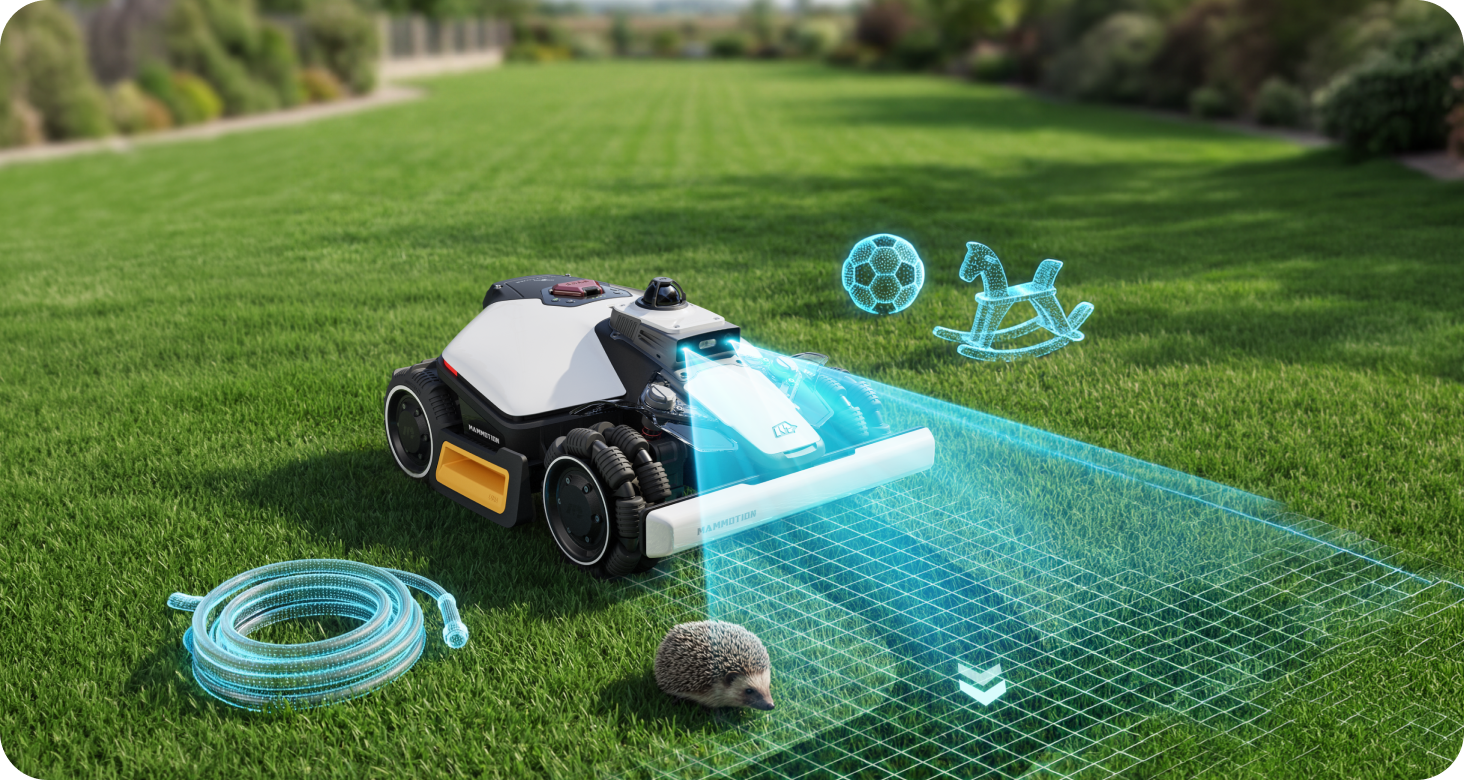
AI Vision combines camera data with deep-learning models capable of recognising and classifying objects. It detects:
- People, children and pets
- Toys, tools, furniture and potential hazards
- Lawn edges and no-go zones
AI Vision doesn’t just "see"—it understands the scene and responds accordingly (slowing down, stopping the blades, or intelligently avoiding obstacles).
- Based on continuous image capture and classical computer-vision techniques such as:
- Edge detection
- Colour and texture analysis
It identifies:
- Natural lawn boundaries
- Non-mowable zones (paths, patios)
- Basic obstacles
Vision can see shapes and contrasts but cannot interpret what the objects actually are.
VSLAM extracts key visual features (textures, corners, walls, edges) to reconstruct a full map of your garden. By comparing consecutive images, the mower calculates:
- Its exact position
- Its orientation
- Its movement through space
This technology enables true boundary-free navigation, allowing the mower to know exactly where it is on a map it builds itself.
Differences Between Vision, AI Vision and VSLAM
| Technology | What It Does |
|---|---|
| Vision | Sees edges and obstacles but doesn’t understand what they are. Vision = Seeing |
| AI Vision | Understands what it sees; recognises people, pets, objects and reacts intelligently. AI Vision = Understanding |
| VSLAM | Knows its precise location by building a map and navigating within it. VSLAM = Positioning |
Beacon-Based Localisation (Beacon / Tag / UWB): A Transitional Approach
Small radio or ultrasonic beacons are placed at strategic points in the garden. The mower triangulates its position using signals from these beacons.
Advantages:
- Very precise in small areas
- Independent of satellite signal
Drawbacks:
- Requires installation of multiple beacons
- Can be expensive
- May disrupt the visual appeal of the garden
Accuracy: Centimetre-level.
Boundary Wire: The Traditional Method
A wire is buried or pegged into the ground to mark the mowing area.
The mower follows the electromagnetic field generated by the wire.
Advantages:
- Highly reliable
- Low initial cost
- Works in all weather conditions
Drawbacks:
- Time-consuming installation
- Wire breaks require repair or replacement
- Not suitable for multi-zone or advanced path planning
Accuracy: Follows the wire line precisely.
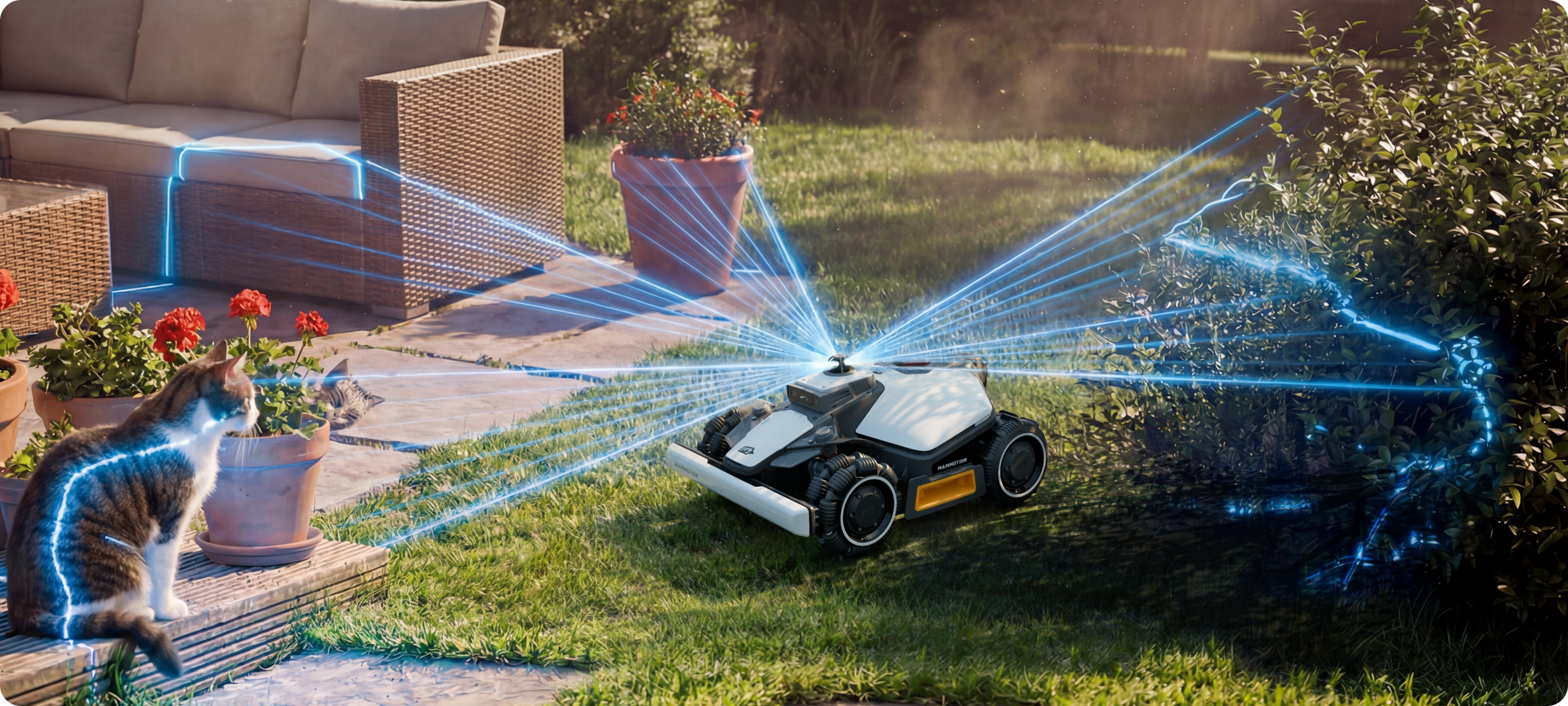
LiDAR (Light Detection and Ranging): 3D Mapping and Obstacle Detection
LiDAR (Light Detection and Ranging) uses laser pulses to measure the distance to objects and surfaces, building a high-resolution 3D representation of the surrounding environment.
Advantages:
- Excellent for detailed environmental mapping.
- Works effectively in the dark or in low-light conditions (it does not depend on ambient light).
- Provides highly accurate proximity measurements.
Drawbacks:
- Does not provide the mower’s global position on its own; it must be fused with a GNSS/RTK system.
- Performance can be affected by heavy fog or intense rainfall.
Accuracy: Centimetre-level accuracy for proximity distance measurements
Part 2. Key Advantages of an RTK Robot Lawn Mower for British Gardens
If you're a British homeowner, you know your garden presents unique challenges that basic automation simply can't handle. The complexity—from the desire for immaculate, striped finishes to dealing with irregularly shaped plots and sloping grounds—is precisely why investing in the best rtk robot lawn mower is a game-changer. These advanced machines are engineered to tackle the specific demands of the UK landscape, moving far beyond the random, boundary-wire-dependent models of the past.
1. Centimetre-Level Accuracy for Perfect Lawn Stripes
For many, the defining feature of a well-kept British lawn is the crisp, dark-and-light striped finish, achieved by cutting the grass in perfectly parallel rows. Traditional rtk robotic lawn mower rivals, often relying on randomized motion or less precise GPS, cannot achieve this look reliably. However, the centimetre-level accuracy of RTK means the mower knows its precise coordinates at all times.
This allows the machine to execute true, systematic, straight-line mowing patterns (single-grid or double-grid), eliminating missed patches and ensuring that iconic, professional-grade striped effect that perfectly matches the UK's traditional lawn culture.
2. Reliable Navigation in Large & Irregular Gardens
British gardens are rarely simple rectangles. They feature tight side passages, multi-tiered areas, sharp corners, and complex flowerbed layouts. While a boundary wire system struggles with multi-zone management and narrow corridors, the RTK system simplifies everything.
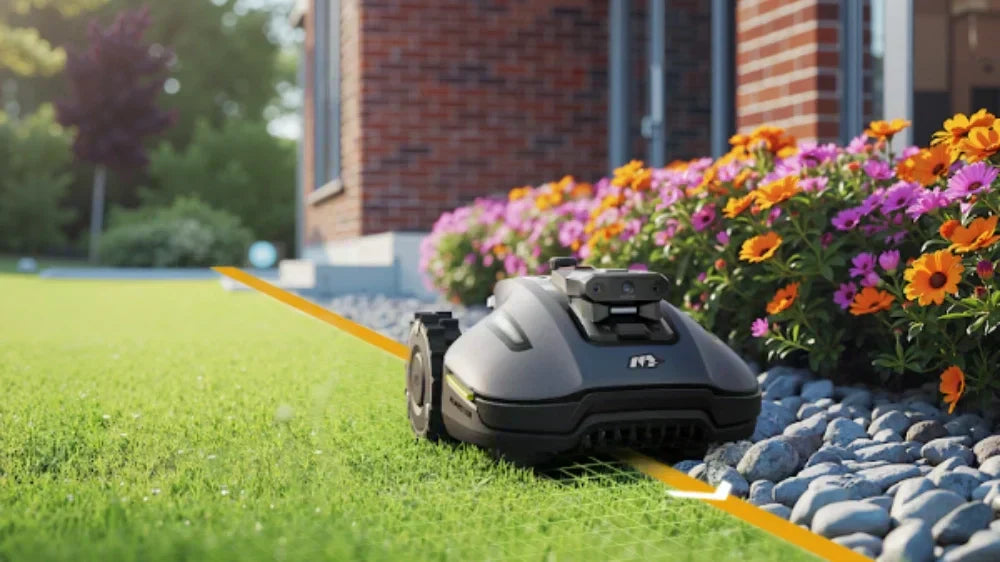
You simply "walk" the virtual perimeter on the app once. Because thertk robot lawn mower maintains its position with such precision, it navigates complex, irregular shapes and tight entry points (e.g., between the house and a shed) flawlessly, consistently returning to the correct path and zone, even across large properties.
3. Truly Wire-Free Operation Without Boundary Cable
Let's be honest: boundary wires are a headache. Installation is time-consuming, and they are perpetually vulnerable to breaks caused by digging, scarifying, or accidental snips. The wire-free promise is perhaps the biggest draw of the best rtk robot mower.
Setup is reduced to installing the base station (or logging into the NetRTK network) and mapping the boundary digitally. This drastically lowers initial setup complexity and eliminates the long-term maintenance costs and frustration associated with repairing broken perimeter cables.
4. Efficient Mowing Patterns (Not Random Movement)
Time is money, even for robots. Non-RTK mowers often rely on random bouncing patterns that require them to run for hours longer just to ensure full coverage. By using RTK’s high-precision coordinates, the mower can calculate and follow the most efficient path—a predetermined, parallel grid. This results in far superior coverage efficiency, meaning your best rtk robot lawn mower finishes the job faster, uses less energy, and reduces overall wear and tear.
Part 3. RTK Robot Lawn Mower Comparison: Mammotion vs Competitors
Choosing the best rtk robot lawn mower means navigating a rapidly evolving landscape of advanced technology. While many brands now feature RTK, their overall positioning, installation requirements, and ability to handle UK-specific challenges (like heavy tree cover or unpredictable weather) vary significantly. Below, we compare the leading rtk robotic lawn mower contenders, highlighting their core navigation stacks.
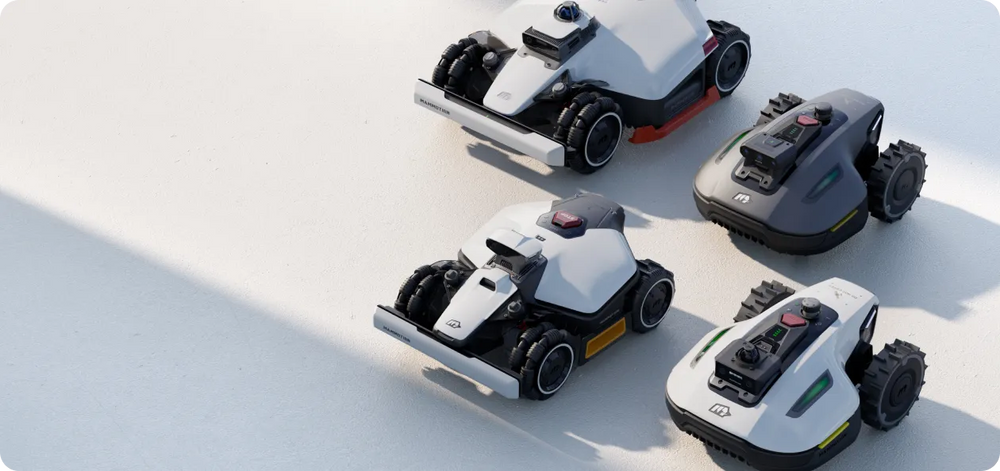
Mammotion LUBA / YUKA
Mammotion's strategy focuses on a multi-sensor approach, which is arguably the most resilient system for the complex UK environment. It combines RTK / NetRTK for centimetre-level global coordinates, AI Vision for smart obstacle recognition, and LiDAR for comprehensive 3D mapping and reliable operation in low-light conditions.
A major unique selling point is its fantastic capability in certain models, offering a Plug-and-Play, zero base station installation experience by leveraging nationwide cellular RTK network correction data. This makes the initial setup of this best rtk robot mower simple and ideal for virtually all garden types in the UK.
In particular, the newly upgraded Mammotion LUBA 3 AWD series stands out.
The 3000 and 5000 models are equipped with an industry-leading tri-fusion navigation system that combines 360° LiDAR, NetRTK, and dual-camera AI vision, delivering precise perception and reliable performance in even the most demanding environments.
Whether operating beneath tree canopies around buildings where signals are easily obstructed, across wide open lawns, or in complex yards with obstacles, steep slopes, or cliff-edge risks, this mower maintains stable navigation and safe operation—making it an ideal solution for large and challenging outdoor spaces.
Kress Mission RTK
Kress offers a compelling rtk robot lawn mower solution, with models relying on a locally installed RTK base station or their newer RTKn (NetRTK) system. Their locally-dependent models are robust for very large, open areas, but, like all local RTK setups, they face challenges in gardens with dense tree coverage or tall surrounding structures that break the signal. Due to the relatively simple technology, performance is limited in areas with obstacles or under tree canopy, where the signal is unstable and cutting effectiveness is affected.
Ecovacs Goat G1
Ecovacs integrates Vision + RTK. The Goat G1 uses RTK for precise path planning and a 360° visual camera for obstacle avoidance and local positioning stability. As a system heavily reliant on visual data (VSLAM), its performance can diminish noticeably in low-light environments or heavy fog, making it less dependable for night mowing or throughout the darker British autumn and winter months when compared to LiDAR-enabled solutions. However, In the presence of tree cover and physical obstacles, signal loss may occur.
Part 4. Why Mammotion Offers Better Real-World Performance in the UK
While RTK provides the required centimetre-level positional accuracy, the UK's typical garden environment—dense tree cover, persistent cloudiness, tight suburban spaces, and unpredictable weather—demands more than just satellite reliance.
This is where Mammotion's system, combining RTK, Vision (AI), and LiDAR, distinguishes itself as thebest rtk robot lawn mower for real-world British performance, offering unparalleled redundancy and stability.
No Base Station Required (NetRTK)
True plug-and-play setup that eliminates the bulky local RTK base station. This solves the common UK installation difficulty posed by dense trees or tall buildings, making setup hassle-free.
Key Advantage: Mammotion NetRTK models receive positioning corrections via the 4G network.
Ultra-Stable Positioning Under Clouds, Trees, or Weak Signal
Mammotion's RTK + AI Vision + LiDAR system offers essential redundancy. When the RTK signal weakens, Vision and LiDAR seamlessly take over positioning stability, ensuring the mower maintains its precise, striped path without stopping or drifting, even in signal dead zones.
Key Advantage: RTK satellite signals can be blocked by trees, clouds, or tall structures ("sky view factor").
Smarter Obstacle Avoidance with AI Vision & LiDAR
Delivers market-leading obstacle avoidance. LiDAR provides high-accuracy, all-weather depth perception, while AI Vision identifies and classifies complex, non-fixed objects (like toys or pets), allowing the rtk robotic lawn mower to intelligently brake and reroute before impact.
Core Function: Integration of AI Vision and LiDAR sensors.
Reliable Night & All-Weather Performance
Unlike VSLAM systems that struggle in poor light, LiDAR uses its own light source (laser pulses). This makes the mower consistently reliable for night mowing and operation during cloudy, damp British weather conditions, ensuring schedules are met regardless of poor UK light.
Core Advantage: Relies on LiDAR technology.
Efficient Mowing Patterns (Not Random Movement)
By replacing random bouncing with systematic, straight-line mowing,Mammotion achieves superior coverage efficiency, reducing runtime and wear and tear.
Core Benefit: RTK's high-precision coordinates allow the mower to calculate and follow an efficient, predetermined, parallel grid path.
Easy Multi-Zone & No-Go Zone Management
Users can define multiple separate mowing zones and instantly set up digital No-Go Zones (like new flowerbeds or pools) with a few taps in Mammotion App, eliminating the need to move or bury physical wires for complex British garden layouts.
Core Feature: Solving the problem of mowing lawns in multiple areas
Conclusion
The era of burying perimeter wires is officially over. The shift towards rtk robot lawn mower technology represents not just an upgrade in machinery, but a fundamental change in how we approach lawn maintenance, especially in the context of rising UK labor costs. For the British homeowner demanding centimeter-level accuracy for that perfect striped finish, reliability under canopy cover, and a hassle-free, wire-free setup, the models like those from Mammotion represent the current pinnacle.
FAQs
1. Does RTK work under heavy clouds or rain in the UK?
Pure RTK can be challenged by heavy cloud cover or dense tree canopy (which is common in the UK). However, the best rtk robot mower systems, particularly those using (RTK + Vision + LiDAR, like Mammotion different robot lawn mower), mitigate this. When the satellite signal is briefly lost, the LiDAR and AI Vision cameras provide real-time environment mapping and positioning data, ensuring the mower maintains its precise path until the RTK signal recovers.
2. Do I need to install a base station?
It depends on the technology. Traditional RTK systems (Local RTK) do require you to install a fixed base station antenna with a clear view of the sky and the mowing area. However, newer NetRTK solutions, such as those offered by Mammotion, eliminate this need. They use cellular networks to receive correction data, offering a truly wire-free and base station-free setup.
3. Is NetRTK stable in rural UK areas with weak 4G?
NetRTK stability is tied to cellular coverage. In areas with weak 4G/5G signal, performance can be intermittent. However, advanced rtk robotic lawn mower models are designed with signal compensation strategies. They often automatically switch to using high-precision IMU (Inertial Measurement Unit) or VSLAM/LiDAR positioning when the cellular signal drops, maintaining positional stability for several minutes until the signal is regained, thus preventing them from getting stuck or losing track.
4. What precision does RTK actually deliver?
RTK (Real-Time Kinematic) technology typically delivers positional accuracy of 1 to 3 centimetres (cm). The practical meaning of this is that the mower can reliably execute perfectly parallel cutting swaths right next to each other, ensuring uniform coverage and allowing it to follow a digital boundary line without missing grass or straying over the edge.
5. Can I use an RTK mower for sloped lawns?
Absolutely. Modern best rtk robot mower systems are designed with powerful motors and complex sensor arrays (including IMUs) to handle significant terrain challenges. Many high-end models, such as the Mammotion series, are capable of handling slopes up to 80%, far exceeding the capability of most older robotic mowers.
Did you like this article? Add us as a preferred source to find us more easily on Google.