




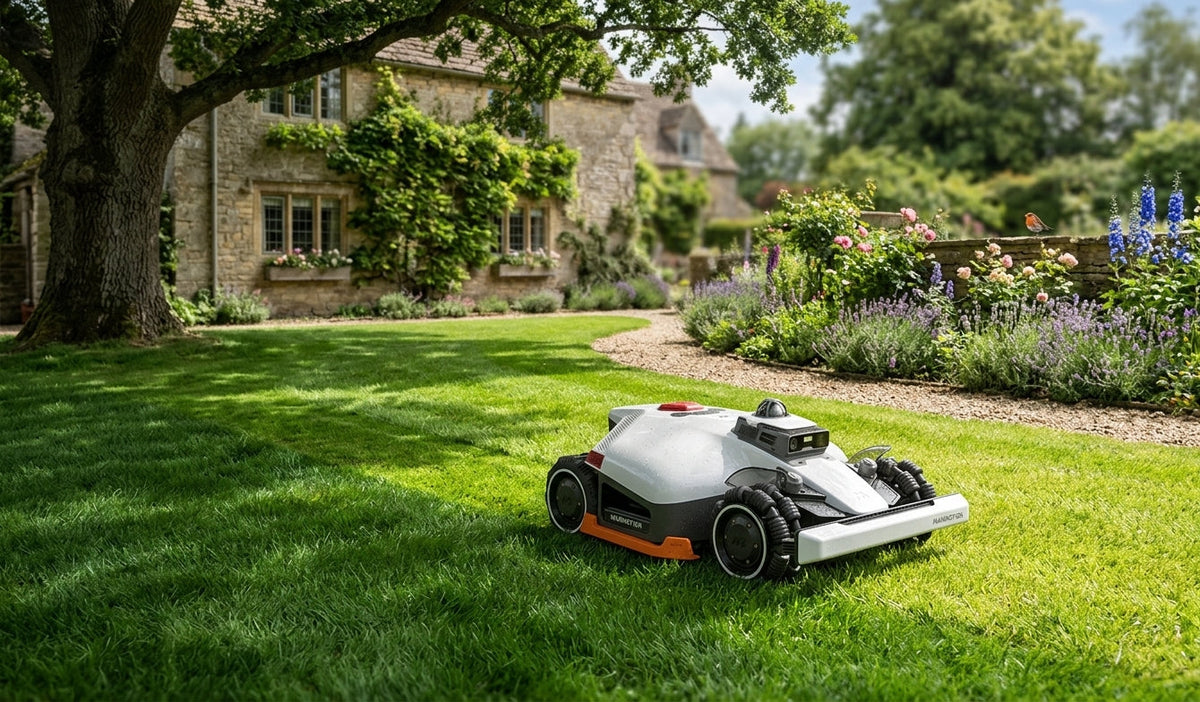
Mowing a lawn in sun and shade can mean keeping up with two different rates of growth. A sunny patch beside the patio may need cutting while the grass beneath a tree or along a boundary wall is barely growing. It is a familiar challenge in gardens across the UK as the growing season gets under way.
With a robotic lawn mower, adjusting mowing frequency and cutting height for each area helps keep both sunny and shaded grass healthy. This guide explains which settings to use and how to adapt them through the seasons.
1. Sun and shade: why one mowing routine falls short
When parts of your lawn grow at different rates, using the same cutting height and mowing schedule can leave some areas too short and others too long. Adjusting your settings to suit the light levels helps you keep pace with the grass.
Why grass grows unevenly
Light plays an essential part in grass growth. In spring, sunny areas generally grow faster when there is enough water and nutrients. The soil also dries out more quickly, which can slow growth during hot, dry spells.
Beneath trees or beside a hedge, limited light often restricts growth and leaves the lawn thinner. Evaporation is lower, but shade does not always mean damp soil: tree canopies intercept some rainfall, and tree roots compete with the grass for water.
| Factor | Sunny area | Shaded area (beneath trees or beside a wall) |
|---|---|---|
| Direct sunlight | Longer periods in the sun | Limited direct light |
| Growth rate | Generally faster in spring when there is enough moisture | Often slower where light is limited |
| Soil moisture | Faster evaporation and a greater risk of drying out | Slower evaporation; poor drainage can lead to waterlogging, while soil beneath trees can become dry |
| Root development | Supported by healthy growth and suitable mowing | Can be weakened by low light levels and competition from trees |
Cutting too short: scalping in sun, moss in shade
An unsuitable mowing routine can weaken different parts of the lawn in different ways:
| Area | Risk | Cause | Result |
|---|---|---|---|
| Sunny area | Scalping | Setting the cutting height too low, particularly on uneven ground. Removing more than one-third of the grass height in one cut is a separate source of stress. | Bare or yellow patches that are more vulnerable to weeds. |
| Shaded area | Weakened grass | Cutting too short and making repeated passes over slow-growing grass. | A thinner lawn, with moss and disease able to develop where conditions favour them. |
2. Get the cutting height and frequency right
For a garden lawn with both sunny and shaded areas, the settings below offer a starting point. Adjust them to suit your grass type and its growth, removing no more than one-third of the grass height in a single cut.
| Area | Cutting height | Suggested frequency | Key principle |
|---|---|---|---|
| Sunny area | 40–50 mm | Up to twice a week in spring, depending on growth | Follow the growth rather than a fixed calendar. |
| Shaded area | 60–70 mm | About once every 7–10 days, leaving longer between cuts as growth slows | Leave longer blades of grass to help them capture the available light. |
3. Seasonal mowing: what to change and when
As the seasons change, review these settings by looking at grass growth and ground conditions in each area.
| Season | Lawn conditions | What to adjust | What to watch |
|---|---|---|---|
| Spring | Growth resumes in the sun; cooler, shaded areas may get going more slowly. | Start mowing each area once the grass has grown enough and excess water has drained away. Aerate compacted patches if needed. | Follow the one-third rule from the first cut. |
| Summer | Sunny areas face heat and drought; grass beneath trees receives less light. | Use mulching in sunny areas. In shaded areas, lightly prune lower branches to let in more light. | Avoid cutting too short during hot spells. |
| Autumn | Growth slows, while fallen leaves and moisture collect, particularly in the shade. | Leave longer between cuts as growth slows, and clear fallen leaves regularly. | Do not leave wet leaves covering the lawn over winter: they can encourage moss and disease and smother the grass. |
| Winter | Grass grows very slowly or becomes dormant; frost and excess water leave the ground more vulnerable to damage. | Usually pause mowing. In mild weather, an occasional high cut is enough if grass is still growing and the ground has drained. Clear leaves and fallen branches, and keep an eye on areas where water collects. | Avoid mowing or walking on frosty, snow-covered or waterlogged grass. |
4. How Mammotion helps manage different cutting heights and schedules
With a conventional lawn mower, juggling two cutting heights and different mowing frequencies takes a fair bit of planning. This is where the wire-free mapping and multi-zone management offered by Mammotion robotic lawn mowers can make a real difference. To choose the right robotic lawn mower for your garden, focus on the following four features (available functions and cutting height ranges vary by model):
| Key Mammotion feature | The sun-and-shade challenge | How the robotic lawn mower helps |
|---|---|---|
| Wire-free mapping | Defining separate mowing areas without installing perimeter wire. | A robotic lawn mower without perimeter wire lets you create distinct areas in the app and organise mowing separately for sun and shade. |
| Adjustable cutting height | Keeping shaded grass longer than sunny grass during spring growth. | On models with electric height adjustment, set the height in the app for each area's tasks; on models with manual adjustment, change it on the robotic lawn mower. |
| Separate mowing schedules | Sunny areas often need more frequent mowing in spring. | Set an independent schedule for each area: for example, twice a week in the sun and once every 10 days in the shade. |
| Navigation for areas with trees | Dense tree canopies can interfere with satellite reception. | Depending on the model, navigation uses a combination of 3D LiDAR, vision or RTK to help the robotic lawn mower find its way around areas with trees. |
Once the tasks are set up, the robotic lawn mower follows the schedule for each area. A few seasonal adjustments keep that routine in step with the lawn's growth.
FAQ
What is a good lawn mowing height in shade?
For the lawn described in this guide, 60–70 mm is a useful starting point in shaded areas. Longer blades of grass provide more surface area to capture light and help avoid weakening the lawn by cutting it too short.
How do I mow between sunny and shaded areas?
Along a hedge or beside a pergola, choose an intermediate cutting height based on the light levels and grass growth. With a model that supports height settings for individual tasks in the Mammotion app, creating an intermediate area can make the change in cutting height less noticeable.
How do I tackle moss in a shaded lawn?
Moss can benefit from low light levels, damp conditions or weakened grass. Its presence alone does not mean the soil is acidic. To help the grass recover:
- Raise a cutting height that is too low, using 60–70 mm as a guide for shaded areas.
- Aerate compacted patches in spring and let in more light by lightly thinning lower branches.
- Once conditions have improved, overseed with a shade-tolerant mix containing grasses such as strong creeping red fescue or slender creeping red fescue.
Can I mow the sunny area while shaded grass is wet?
Yes, you can mow the sunny area once the grass is dry and the ground is firm, leaving the shaded area until it has dried. With a robotic lawn mower, mow the dry area separately only if you can keep it within that area and its route does not take it across the wet ground.
Should I collect grass clippings from shaded areas?
Yes. Collect clippings from shaded areas, especially where they form clumps over thin grass. The summer mulching advice in this guide applies to sunny areas; in the shade, clear the cut grass rather than leaving it to cover the lawn.
Conclusion
Mowing a lawn in sun and shade works best when cutting height and frequency follow the growth in each area. This helps the grass stay dense and cope better with limited light or dry weather. The mapping and multi-zone scheduling features on Mammotion's wire-free robot lawn mowers make it easier to organise your lawn care and adjust settings as the seasons change.

Did you like this article? Add us as a preferred source to find us more easily on Google.