






With the return of warmer days, it is time to recommission your pool and bring it out of its winter hibernation. Since manual maintenance is often tedious and time-consuming, acquiring an automatic pool vacuum has become a priority for any homeowner wishing to enjoy their garden without the hassle of manual brushing.
To choose the right robot pool cleaner in 2026, you should prioritise a device suited to your pool’s lining (whether liner, tile, or fibreglass) and its specific configuration (slopes, steps). The major trend this year is the shift towards the cordless robot pool cleaner, offering total freedom of movement and enhanced safety without the clutter of trailing cables.
In this 2026 guide, we analyse the essential technical criteria—from suction power to onboard intelligence—to help you find the cleaner that will turn your weekly chore into a distant memory.
Part 1: What are the benefits of a robot pool cleaner?
Using a robot pool cleaner can reduce your weekly maintenance time by up to 80% while significantly improving water clarity. By actively scrubbing the walls and filtering debris autonomously, it eases the load on your main filtration system and decreases the consumption of chemical treatments. This is particularly beneficial for British gardens, where wind-blown organic matter can often upset the chemical balance of the water.
1. Saving Precious Time
Using a manual pool vacuum is arguably the most thankless task of garden maintenance. On average, a pool owner spends 2 to 3 hours a week trying to scrub away stubborn dirt and debris. By delegating this chore to a robot pool cleaner, you reclaim that time to actually enjoy a swim or relax in your outdoor space.
2. Deep Cleaning Performance
Unlike a simple surface skim, a robot pool cleaner performs an active scrub of your pool's interior. Equipped with high-speed brushes, it dislodges microscopic algae and calcium deposits from the liner or tiles before they can take hold. This mechanical action is crucial for preventing cloudy water—a common issue during the increasingly warm British summers when water temperatures can spike.
3. Reduction in Chemical Usage
On average, users of these electric devices see a 15% to 20% reduction in the use of disinfectants over a full season. This not only saves money but also results in a gentler swimming environment for your skin and eyes.
4. Long-term Savings
Unlike manual cleaning or basic suction cleaners, a high-performance robot pool cleaner effectively captures leaves, grit, and insects in its own internal filtration system. This prevents debris from clogging the pump’s pre-filter or the main sand filter. Consequently, there is less strain on your primary filtration system, reducing wear and tear and extending its overall lifespan.
Furthermore, by limiting the frequency of backwashing, you save hundreds of litres of treated water each year. This not only lowers your water bills but also reduces the consumption of chemicals and the overall time dedicated to maintenance.
Part 2: How to Choose Your Robot Pool Cleaner: The 12 Key Criteria
When choosing a robot pool cleaner, it is essential to first consider the characteristics of the pool itself—such as the type, size, shape, and lining—as these determine the suitable model, brush type, and installation method.
Next come the cleaning performance factors, notably the coverage areas (floor, walls, or waterline), suction power, and the precision of the filtration system, which directly impact cleaning efficiency. Ergonomics and ease of use are equally vital: battery life, intelligent path planning, and daily manoeuvrability.
Finally, the budget and maintenance costs—including the initial price, replacement parts, and ease of removal from the water—determine the long-term value of the investment. Pool specifications and cleaning efficiency are the primary factors, followed by user comfort and cost management.
| No. | Factor | Importance | What It Affects | Options | Complexity | Priority | Recommendation |
|---|---|---|---|---|---|---|---|
| 1 | Pool Type | ⭐⭐⭐⭐⭐ | Determines compatibility and installation | Private, public | Low | Critical | Always check your pool type first to avoid choosing an incompatible robot |
| 2 | Cleaning Coverage | ⭐⭐⭐⭐⭐ | Defines which areas are cleaned | Floor / Floor + Walls / Floor + Walls + Waterline | Medium | Critical | For less effort, choose a robot that can clean the waterline |
| 3 | Budget & Maintenance Costs | ⭐⭐⭐⭐⭐ | Long-term cost of ownership | All | Medium | Critical | With a limited budget, balance features and price carefully |
| 4 | Pool Size | ⭐⭐⭐⭐ | Affects cleaning time and runtime | Small / Medium / Large | Low | Critical | Match battery life or cycle time to your pool size |
| 5 | Shape & Complexity | ⭐⭐⭐⭐ | Impacts cleaning coverage | Simple rectangular to freeform | Medium | Functional | Complex shapes require robots with smart navigation |
| 6 | Installation Type | ⭐⭐⭐⭐ | Ease of use and compatibility | Skimmer, booster pump, mains-powered, battery | Medium | Critical | Choose based on your existing pool setup |
| 7 | Suction & Brushing Power | ⭐⭐⭐⭐ | Determines cleaning performance | All | Medium | Functional | Pools with heavy debris (e.g. leaves) need stronger suction |
| 8 | Filtration System | ⭐⭐⭐⭐ | Water quality and maintenance frequency | All | Medium | Functional | Removable filters are easier to clean and maintain |
| 9 | Battery Life | ⭐⭐⭐⭐ | Maximum coverage per session | Small / Medium / Large | Low | Comfort | Larger pools require longer battery life |
| 10 | Smart Features | ⭐⭐⭐⭐ | Automatic navigation and efficiency | High-end models | Medium | Comfort | Smart mapping reduces manual intervention |
| 11 | Ergonomics | ⭐⭐⭐⭐ | Ease of handling | All | Low | Comfort | Lightweight designs are easier to lift and handle |
| 12 | Pool Surface | ⭐⭐⭐ | Determines brush type | Liner, tiles, shell | Medium | Functional | Tiles need harder brushes, liners require softer ones |
Your Pool: The Starting Point
1. Pool Type
Whether it is above-ground or inground, each structure imposes different constraints. Inground pools often require a robot pool cleaner capable of climbing the walls, while a simpler model may suffice for a tubular structure.
2. Pool Size
Never underestimate the total surface area of your pool. The size of the basin is a determining factor in choosing a suitable robot pool cleaner, as an undersized device may fail to complete the cleaning cycle before running out of battery or power.In 2026, robot pool cleaner models are generally classified by their cleaning capacity per session, for example: up to 50 m², 100 m², 200 m², or more.
For a small pool (less than 50 m²):
Almost all cordless or corded robots will be suitable.
For a medium pool (50-100 m²):
It is advisable to check the battery life and cleaning speed to avoid interruptions.
For large pools (over 100 m²):
Prioritise models with long autonomy, potentially rechargeable between two cycles, or corded models to ensure a complete clean without motor fatigue.
3. Shape and Complexity

If your pool has a diamond point floor, steep slopes, or corner stairs, avoid basic robot pool cleaner models with random movement patterns. You need an algorithm capable of mapping these obstacles.
4. Pool Lining
Liner, tile, polyester shells, or painted concrete do not all provide the same level of grip.
|
Surface Material |
Recommended Brushes |
Notes / Tips |
|
Fibreglass |
Soft brushes |
Prevents scratches on smooth surfaces |
|
Vinyl |
Soft brushes |
Protects against punctures or abrasions |
|
Tiles |
Hard or combination brushes |
Removes limescale and stubborn dirt |
|
Pebbles |
Soft or combination brushes |
Avoid scratching the pebbles; choose an adaptable robot |
|
Stone |
Combination brushes |
Removes deposits while respecting surface texture |
|
Concrete |
Hard brushes |
Durable surface, effective cleaning |
|
Liner |
Soft brushes |
Preserves the lining, prevents tears or scratches |
5. Installation Mode and Compatibility
1. Suction-Side Hydraulic Robot Pool Cleaner

Connects directly to the pool's skimmer and uses the existing pump to vacuum debris.
- Features: No electricity needed in the water; simple and economical operation.
- Ideal for: Small pools or limited budgets.
- Model examples: Zodiac T3, T5.
2. Pressure-Side Robot Pool Cleaner(Booster Pump)

Requires an additional pump installed in the plant room, which creates pressure to move the machine.
- Features: Very powerful, capable of moving large debris such as leaves and twigs.
- Ideal for: Pools located in heavily wooded gardens.
- Model examples: Polaris 280, Polaris F9550.
3. Corded Electric Robot Pool Cleaner

Plugged into a mains socket via a transformer, it operates autonomously thanks to its integrated motor.
- Features: Complete and consistent cleaning of the floor, walls, and sometimes the waterline.
- Ideal for: Pools requiring regular intensive cleaning.
- Model examples: Dolphin Nautilus, Dolphin S300i.
4. Cordless Robot Pool Cleaner (Battery)

Operates on a rechargeable battery, without clunky cables or transformers.
- Features: Quick to launch, total freedom of movement, suited for complex shapes, modern and practical design.
- Ideal for: Modern gardens, free-form or complex pools, quick and flexible use.
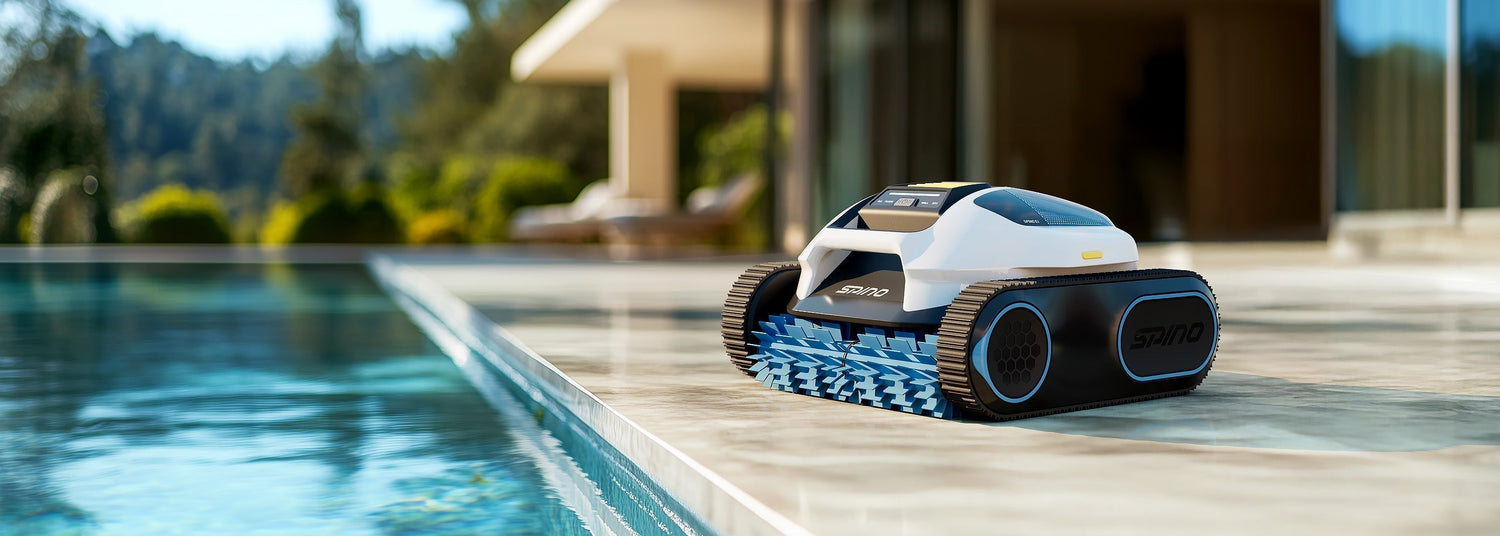
- Model examples: Mammotion SPINO E1
Cleaning Performance (Efficiency Above All)
6. Cleaning Zones
When choosing a robot pool cleaner, it is important to define which parts of the basin you wish to clean:
Floor only
An economical option, ideal for basic maintenance. It is suitable for pools with low usage or for users who regularly clean the walls manually.
Floor + Walls
Allows for a more complete clean by removing dirt and deposits from the pool walls, thereby reducing manual maintenance.
Floor + Walls + Waterline
The highest standard of cleaning. The waterline is particularly prone to the accumulation of grease (sun creams, body oils) and limescale. A robot capable of cleaning it saves you from tedious manual scrubbing and ensures a visually impeccable pool.
7. Suction Power and Scrubbing
The performance of a robot pool cleaner depends mainly on its suction capacity (expressed in m³/h) and its scrubbing system.
- Suction: Sufficient power allows for the effective capture of leaves, debris, and fine dirt, even in hard-to-reach areas.
- Active Brushes: Quality robots feature brushes that rotate faster than the wheels, which helps to dislodge and eliminate green or brown algae, limescale deposits, and other m³/h stubborn grime on the floor and walls.
8. Filtration System
The performance of a robot pool cleaner depends heavily on the precision and practicality of its filtration system.
50–200 micron filters
Retain standard debris such as leaves, twigs, and insects.
10–50 micron filters
Capture fine particles, pollen, and sand for clearer water.
<10 micron filters
Retain the finest impurities, dust, and micro-debris, offering high-precision cleaning.
Comfort of Use
9. Battery Life
For cordless robots, battery autonomy is an essential criterion to ensure a complete clean.
Charging time / working time ratio: Check how long the robot can operate on a full charge compared to the time required to clean your pool. A robot with insufficient autonomy risks failing to finish the cycle and may require several interruptions to recharge. Practical advice according to pool size:
Small pools (<50 m²):
Short autonomy may suffice, as cleaning is completed quickly.
Medium pools (50–100 m²):
Prioritise a model whose autonomy covers the entire basin, or one featuring fast charging.
Large pools (>100 m²):
Opt for a robot with long autonomy, or even an automatic resume function after recharging, to guarantee a complete clean without interruption.
10. Intelligent Navigation
Modern robot pool cleaner models integrate advanced sensors to optimise their navigation and maximise cleaning efficiency:
- Intelligent Navigation: Thanks to sensors (often based on LiDAR or ultrasound), the robot automatically plans its trajectory in an S or N pattern, avoiding multiple passes over the same spot and systematically covering the entire basin.
- Mobile App: Many models allow you to programme personalised cycles, start or stop the robot remotely, and track progress in real time.
Budget and Cost
11. Price and Maintenance
When choosing a pool cleaning robot, it’s important to look beyond the initial purchase price and consider the overall cost of ownership. High-end models may offer advanced features such as smart navigation, longer battery life, and more comprehensive coverage, but they come with a higher upfront cost. Look for robots with removable, easy-to-clean filters and brushes, ideally tool-free. Easier maintenance keeps the robot running efficiently, extends its life, and reduces replacement costs.
12. Weight and Handling
The weight of the robot affects how easily you can handle it, especially when removing it from the pool. Lightweight designs with ergonomic handles make it simpler to lift, carry, and store the robot. When choosing a robot, consider the combination of weight, size, and handle design to ensure it is practical for your daily use.
Part 3. Why is the Mammotion SPINO E1 cordless robot pool cleaner the best choice?

After analysing the 12 essential criteria for choosing a robot pool cleaner — basin compatibility, suction power, autonomy, intelligent navigation, maintenance, and cost — it is clear that a model capable of combining all of these would be ideal.
This is precisely what the Mammotion SPINO E1 cordless robot pool cleaner offers: a 100% cordless robot, capable of cleaning the floor, walls, and waterline with exceptional precision, while offering practical and autonomous cleaning.
Key Features Supported by the SPINO E1
✅ Suitable for all pool types and linings: liner, tile, concrete, stone, pebbles, fibreglass, vinyl
✅ Compatible with all basin shapes and sizes, including large modern pools
✅ Complete cleaning: floor, walls, and waterline
✅ Powerful suction and active brushes for algae, fine dirt, and stubborn deposits
✅ Efficient filtration: removable canisters with different levels of precision
✅ Long and intelligent autonomy: Up to $150\text{ m}^2$ of coverage, with up to 4 hours of continuous operation
✅Intelligent Navigation: advanced sensors for optimal coverage
✅ Mobile app control: programming of personalised cycles and real-time tracking
✅ Simple and cordless installation: total freedom, quick launch, no tangled cables
✅ Lightweight and ergonomic: practical handle, quick water drainage, easy to handle
✅ Easy maintenance: accessible filters and brushes, easy-to-find spare parts
✅ Durable investment: robust, repairable, ideal for long-term use
✅ 5 cleaning modes to choose from: Select between Floor, Walls, Auto, or Eco mode (cleaning 3 times a week for 50 minutes) directly on the device. For deep cleaning, activate the powerful Max mode via the SPINO app.
If analysing the 12 criteria seems too complicated, simply opt for the Mammotion SPINO E1: it brings together all the key features, without compromise between performance and practicality, to offer you an optimal pool cleaning experience.
Conclusion
Choosing the right robot pool cleaner is the best investment to extend the life of your pool and maximise your swimming enjoyment. Having taken into account the 12 essential criteria mentioned above, you now know how to select the ideal robot for your basin.
If you are looking for performance and practicality combined, the Mammotion SPINO E1 is the perfect choice. Its cordless technology combines professional efficiency with ease of use at home, transforming tedious pool maintenance into a totally automatic and effortless experience.
FAQ
What is the lifespan of a robotic pool cleaner?
Generally, a well-maintained pool robot has an average lifespan of 5 to 8 years.
Can I leave my pool robot in the pool all the time?
No, this is not recommended. Leaving it plugged in or in the water can lead to overheating, pose electrical safety risks, and accelerate the wear and tear of the device. It is advised to run a normal cycle of 2 to 3 hours, then unplug the robot and store it in a dry place.
Which is the most reliable pool robot?
Classic brands like Dolphin and Polaris are well-known, but the Mammotion SPINO E1 is now a top contender for its technological robustness. While the Polaris 280 is valued for its historical sturdiness, the SPINO E1 offers modern, high-performance reliability.
Did you like this article? Add us as a preferred source to find us more easily on Google.