



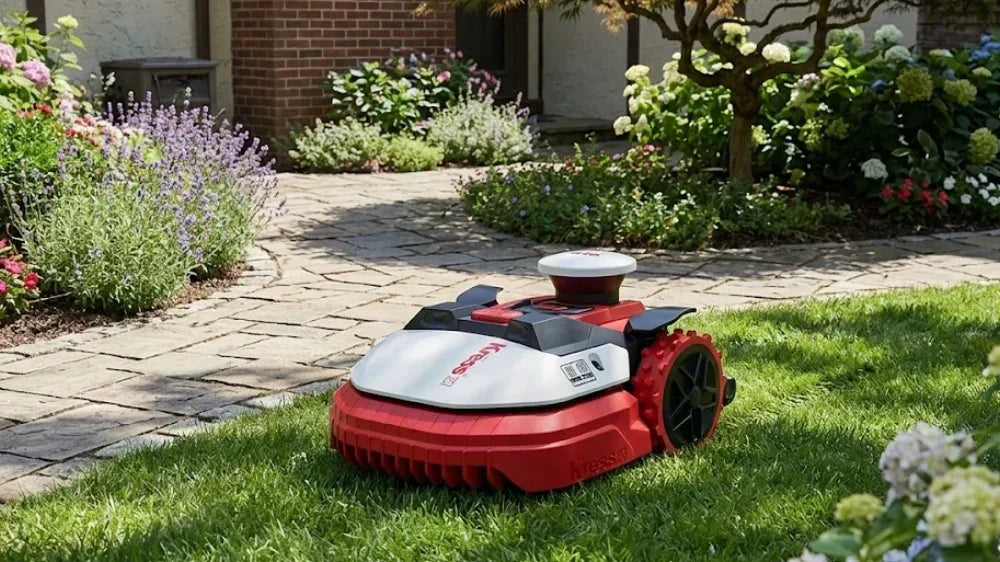
Are you looking for an expert Kress robotic lawn mower review to revolutionise your lawn care routine? Kress is by no means a newcomer to this market. Rooted in the world of professional landscaping tools, this German manufacturer has forged a solid reputation thanks to cutting-edge engineering and heavy-duty reliability.
However, the brand's product lineup is exceptionally vast: whilst certain robot lawn mowers models are perfectly suited for small urban gardens, others are true powerhouses designed to tackle sports pitches or steep slopes. So, in 2026, does Kress retain its title as a technological leader?
In this article, we closely examine the brand's various ranges, its exclusive technologies, and genuine user experiences. Finally, we will present the best market alternatives to help you make the wisest choice for your specific garden layout.
Part 1. What You Need to Know?
Before diving into the technical details, it is essential to understand the DNA of this brand. Kress is by no means a newcomer to the power tool market. Of German origin and now part of the Positec Group, the brand has established a stellar reputation in the UK, particularly among professional landscapers and owners of large estates.
Unlike many brands sold exclusively online, Kress relies on a dedicated network of local dealerships for professional installation and after-sales service—a highly reassuring factor for the average British consumer. The product portfolio is extensive, spanning from compact models tailored for urban gardens to commercial-grade machines capable of managing multiple hectares.
Part 2. Overview of the Different Kress Robot Lawn Mowers Ranges
The Kress robotic lawn mower range is categorised into three main product families: RTKⁿ, EyePilot, and Mission / Mission Mega. Each series caters to distinct requirements based on navigation technology, mowing area, and garden complexity.
The essential point to grasp is that the manufacturer does not offer a single one-size-fits-all model, but rather a progressive technological framework moving from the most straightforward to the highly advanced. This is where the true distinction between generations and specifications becomes clear:
| Series | Positioning | Core Technology | Optional Features | Obstacle Detection | Drive System | Recommended Area | Price | Key Features |
|---|---|---|---|---|---|---|---|---|
| Mission Nano | Entry-level / small gardens | Perimeter wire | No | No | RWD | Up to 1000 m² | €599 | Compact, highly maneuverable, ideal for narrow passages and small gardens |
| Mission | Mid-range residential | Perimeter wire | OAS (optional by version) | Yes (model dependent) | RWD | 1500–2500 m² | €699–€1399 | Best value for standard residential lawns |
| Mission Mega | Large areas / semi-pro | Perimeter wire | No | Yes (OAS integrated) | RWD | 4400–6500 m² | €1999–€2499 | High performance, dual cutting disk, wide cutting width for large properties |
| RTKn Series | High-end wire-free | RTK satellite positioning | OAS (optional) | Yes (model dependent) | RWD | 600–28000 m² | €799–€59999 | No perimeter wire, straight-line mowing, high efficiency |
| EyePilot | Premium / complex environments | RTK + AI vision | ZeroTrim, 4G, advanced functions | Yes (AI camera) | RWD / AWD | 500–5000 m² | €999–€4499 | Most advanced 2026 series, works under trees and weak signal, highest intelligence level |
1. RTKⁿ (Wireless Boundary Navigation)
The RTKⁿ series relies on satellite positioning technology (RTK), which delivers centimetre-level precision.
- No boundary wire installation required
- No need for a rooftop antenna on your house (utilises a proprietary RTK network)
- Faster and cleaner commissioning process
- Perfectly suited for modern residential gardens
2. EyePilot (RTKⁿ + AI Vision)
The EyePilot range represents the most advanced technological tier from Kress in 2026.
- Combines RTK navigation with an intelligent camera (AI / V-SLAM)
- Vision-assisted navigation in real time
- Performs significantly better under dense tree canopies or close to high walls
- Maintains exceptional stability even when satellite signals are obstructed
In practice, this means the equipment no longer depends solely on GPS signals, but also utilizes "its own eyes" to navigate through complex environments.
3. Mission / Mission Mega (Traditional Wired Technology)
The Mission and Mission Mega series represent the more classic approach.
- Utilises a buried boundary wire to define the mowing area
- Proven and highly stable technology
- Less flexible than wireless alternatives
- Mission Mega is optimised for expansive areas and demanding terrains
This product structure allows the manufacturer to cover a diverse range of needs, but it also means selecting the right model is particularly crucial depending on your specific garden layout.
Part 3. Kress RTK Robot Lawn Mowers Review
The RTK technology utilised by Kress enables mowing without a boundary wire while maintaining centimetre-level precision. However, its real-world performance depends heavily on the garden environment, such as tree cover, walls, and satellite availability.
RTK (Real-Time Kinematic) technology is currently at the heart of wireless Kress robotic lawn mowers. It completely replaces legacy buried cable systems by relying on satellite signals corrected in real time. In practice, the machine no longer "guesses" its position; it knows it with accuracy up to the centimetre, enabling far more structured and efficient navigation paths.
When operating these RTK models, the device receives GNSS data and subsequently corrects it via a network of reference stations. This process allows for systematic parallel-line mowing that closely mimics the work of a professional greenkeeper. In theory, this ensures flawless coverage of the lawn and minimises missed spots.
For domestic use in the UK (gardens with hedges, trees, and semi-detached or terraced houses), RTK brings genuine simplification to lawn care:
- No boundary wire installation required
- Rapid initial mapping of the terrain
- Optimised straight-line navigation paths
- More precise multi-zone management
However, plenty of user reviews indicate that the technology can be sensitive to complex environments. For instance, beneath dense tree canopies or in close proximity to high walls, the satellite signal can be obstructed, which sometimes results in micro-corrections to the navigation path or temporary losses of precision.
Part 4. Top Kress Robot Lawn Mowers Review: Which Series Should You Choose in 2026?
In this kress robot lawn mower review, we focus on the most popular RTKⁿ series, which is widely preferred by buyers. This analysis is also based on broader kress robotic lawn mower review insights and real-world user feedback, helping to better understand different models within the range.
The models we mainly analysed include:
- Kress KR161E robot lawn mower review
- Kress KR121 E robot lawn mower review
- Kress KR122E robot lawn mower review
- Kress KR123E robot lawn mower review
In addition, to provide a more complete overview of the range, we also included two additional models:
- KR133E from the Mission Mega series
- KR285E from the EyePilot series
| Features | KR161E | KR121E | KR122E | KR123E | KR133E | KR285E |
|---|---|---|---|---|---|---|
| Kress Series | RTKⁿ | RTKⁿ | RTKⁿ | RTKⁿ | Mission Mega | EyePilot |
| Max area (72h) | 1000 m² | 1500 m² | 2000 m² | 2500 m² | 4400 m² | 5000 m² |
| Price (incl. VAT) | €1299 | €799 | €1099 | €1399 | €1999 | €4499 |
| Navigation system | RTKⁿ | RTKⁿ | RTKⁿ | RTKⁿ | INTIVA | RTKⁿ + AI Vision |
| Wired / wireless | Wireless | Wireless | Wireless | Wireless | Wired | Wireless |
| Drive system | RWD | RWD | RWD | RWD | RWD | AWD |
| Max slope | 35% (20°) | 35% (20°) | 35% (20°) | 35% (20°) | 45% (24°) | 84% |
| Battery | 4 Ah | 4 Ah | 4 Ah | 5 Ah | 6 Ah | 10 Ah |
| Weight | 12 kg | 11.8 kg | 12 kg | 12.1 kg | 19 kg | 20.2 kg |
| Blades | 3 | 3 | 3 | 3 | 2 | 4 |
| Cutting height | 30–60 mm | 30–60 mm | 30–60 mm | 30–60 mm | 30–60 mm | 20–70 mm |
| Height adjustment | Electronic | Button | Button | Button | Electronic | Electronic |
| Cutting width | 200 mm | 220 mm | 220 mm | 200 mm | 350 mm | 240 mm |
| 4G | ✕ | ✕ | ✕ | ✕ | ✕ | ✔ |
| Wi-Fi / Bluetooth | ✔ | ✔ | ✔ | ✔ | ✔ | ✕ |
| Smart navigation | ✕ | ✕ | ✕ | ✕ | ✕ | ✕ |
| AI detection (OAS) | ✔ | ✔ | ✔ | ✔ | ✔ | ✕ |
| Lawn patterns | ✕ | ✕ | ✕ | ✕ | ✕ | ✕ |
| Noise level | 61 dB | 61 dB | 61 dB | 61 dB | 59 dB | 62 dB |
| Water resistance | IPX4 | IPX4 | IPX4 | IPX4 | IPX5 | IPX6 |
Overall, these kress robotic lawn mower reviews highlight clear differences between entry-level and more advanced systems, making it easier for users to compare performance, navigation technology, and use cases before choosing a model.
KR161E
The KR161E is an intelligent robot from the Kress RTKⁿ range designed for small gardens. It focuses on a user experience that combines lightweight design with electronic control. For lawns of up to 1000 m², this model enables quick deployment thanks to RTKⁿ wire-free navigation, while also offering enhanced convenience through its electronic cutting height adjustment.
KR121E
The KR121E is the most affordable entry-level model in the RTKⁿ series. Its main goal is to deliver wireless technology at the best possible price. Capable of covering up to 1500 m², it is an ideal choice for replacing a traditional lawn mower.
KR122E
Based on the KR121E, the KR122E extends coverage up to 2000 m². It is a balanced mid-range model that sits between performance and price, designed for families who require greater mowing efficiency.
KR123E
The KR123E is the advanced model of the RTKⁿ series. With an upgraded 5Ah battery, it delivers improved endurance and more stable performance on lawns of up to 2500 m².
KR133E
The KR133E belongs to the Mission Mega series. It is a traditional robot designed for very large areas. It uses INTIVA perimeter wire navigation: although installation is more complex, it delivers excellent stability and efficiency across wide spaces.
KR285E
The KR285E is Kress’s flagship model. It combines RTKⁿ navigation with AI vision and features AWD all-wheel drive. Designed for extremely large lawns and challenging terrains, it represents the highest level of intelligence and mobility in the range.
Part 5. Advantages and Disadvantages
Choosing a robot lawn mower in 2026 is a strategic investment for your garden. To help you decide, here is an objective summary of the strengths and weaknesses based on user feedback and the technical specifications of the brand.
Advantages
Simplified wire-free installation
The key advantage lies in the RTKⁿ technology. Unlike other brands, Kress relies on a network of professional local antennas. As a result, you do not need to install your own reference base on the roof, which significantly simplifies setup.
Ultra-fast professional mapping
The commissioning process is greatly improved by authorised dealers. Equipped with a high-precision RTK measuring trolley, they can define your garden boundaries in record time. For large areas, this saves considerable time compared to manual smartphone-based setup.
Safety first with OAS
The patented Obstacle Avoidance System (OAS) allows the robot to detect hazards without contact. This provides peace of mind for families with children or pets. However, it is worth noting that this technology also affects the final price.
Intelligent energy management (RBS)
Kress integrates a Regenerative Braking System (RBS). During slopes or deceleration, kinetic energy is converted into electricity to recharge the battery, optimising each mowing cycle.
Impeccable finishing with ZeroTrim
For users who dislike manual edge trimming, the ZeroTrim offset cutting deck is a major advantage. It allows mowing as close as 2 cm from edges, significantly reducing the need for a separate edger.
Attractive entry price point
With wireless models available for under €1000, Kress democratises access to RTK technology for first-time users with a controlled budget.
Disadvantages
Occasionally disappointing traction
Most models rely on a 2-wheel drive (2WD) system. On wet lawns or sloped terrain common in certain regions, the robot may struggle for grip and slip, where AWD (4x4) systems would perform significantly better.
Frequent charging cycles
The built-in batteries, typically 4Ah or 5Ah, limit effective working time. On larger properties, the robot spends a significant portion of its time returning to the charging station, extending the overall mowing duration.
Imperfect water resistance
This is a critical concern. With protection ratings ranging from IPX4 to IPX6, full hose cleaning is not always recommended, especially for the chassis. Insufficient sealing underneath the machine may lead to failures after rain or during cleaning, increasing maintenance costs.
Vulnerability in shaded areas
Relying solely on RTK navigation, some models may lose positioning under dense trees or near tall buildings. Without visual assistance (available only on higher-end versions), the robot may stop when signal is lost.
Limited modern connectivity
Surprisingly for 2026, not all models include native Wi-Fi or 4G connectivity. The inability to perform remote scheduling or receive OTA (Over-The-Air) updates creates a technological gap compared to smart home standards.
Partial automation experience
Manually adjusting cutting height via a rotary dial feels outdated. In addition, smart features such as lawn printing or garden camera monitoring are missing from most configurations.
Paid safety features
Although the OAS (Obstacle Avoidance System) performs well, it is not standard across all models. Users often need to upgrade or pay extra to access active obstacle protection.
Part 6. Is Kress suitable for all gardens?
The Kress robot mower range, with its multiple series, appears to offer a solution for every type of user profile. By introducing RTKⁿ models priced under €1000, the brand has clearly succeeded in democratising access to wire-free mowing. However, this accessibility hides a more complex reality: Kress is built on a layered product structure rather than a universal solution capable of solving every garden scenario.
A segmentation that defines performance
Although competitive in terms of pricing, the brand still lags behind ultra-high-end flagship models in terms of pure intelligence and operational efficiency. This performance gap is explained by a strict hierarchy of features depending on the selected model:
- Hardware capacity: Battery size and number of blades vary significantly between series, directly impacting runtime and cutting efficiency.
- Premium options: Key technologies such as 4G connectivity, Zero-trim edge cutting, AWD all-wheel drive, and the OAS obstacle avoidance system are not standard across the range, but depend on the model tier selected.
Real-world terrain challenges vs laboratory conditions
In reality, a French garden is rarely a perfect rectangle of grass. This is where the limitations of certain Kress models become more visible:
- Signal stability: A system based solely on RTKⁿ navigation may show weaknesses under a pergola or in the shadow of a large stone wall.
- Slope management: RWD (rear-wheel drive) models quickly reach their limits on hilly terrain, where 4x4 traction becomes essential to prevent the robot from getting stuck or slipping.
- Unexpected obstacles: In a “living” garden, the OAS system is no longer a luxury but a necessity to ensure smooth mowing without repeated collisions.
In 2026, “high-end” standards have evolved. Users now expect features that are becoming the norm: intelligent multi-zone management, app-based electric cutting height adjustment, lawn printing customisation, enhanced waterproofing, and integrated video monitoring.
Within the Kress ecosystem, accessing this full suite of features often requires moving significantly up the product range, which increases the overall cost.Kress is not a “one-size-fits-all” solution.
It is a brand that works very well if you can correctly identify the model that matches your specific constraints. For a small and simple garden, the entry-level range offers excellent value for money. However, for complex terrains requiring full automation and superior climbing ability, investing in the higher-end models is necessary to avoid performance disappointment.
Part 7. The best alternative to Kress robot mowers in 2026: Why choose Mammotion?

While Kress has earned user trust through its well-established physical dealer network, Mammotion is emerging in 2026 as the preferred choice for users who demand higher automation and stronger raw performance.
The fundamental difference lies in product philosophy. In many kress robot lawn mower reviews, key features such as AWD, vision systems, and 4G connectivity are often segmented across different models or offered as paid upgrades. In contrast, Mammotion integrates these technologies natively as standard on its flagship LUBA 3 AWD range. This approach significantly simplifies the user’s decision-making process while ensuring a more balanced and consistent performance level.
Why does Mammotion dominate complex terrains?
1. Standard AWD transmission: the master of slopes
Unlike most Kress models, which rely on rear-wheel drive (RWD), the Mammotion LUBA series comes as standard with all-wheel drive (AWD). This results in exceptional grip on wet grass and uneven terrain. Its climbing capability reaches 80% (38.6°), whereas Kress models generally sit between 35% and 45%.
2. Triple-fusion navigation: unmatched stability
Mammotion goes beyond standard RTK by combining AI Vision and 3D LiDAR. This “triple system” allows the robot to instantly switch navigation modes when satellite signals become weak (for example under dense trees or near tall walls). In contrast, a kress robot lawn mower RTK review often highlights stability limitations in such shaded environments.
3. Intelligent path planning
Thanks to optimised algorithms, Mammotion reduces unnecessary overlap, which leads to:
- Improved mowing efficiency
- Significantly reduced working time
- Lower battery energy consumption
4. Advanced AI obstacle recognition
The 2026 Mammotion models feature an AI chip capable of identifying more than 300 types of objects, including anti-fall detection. This ensures a high level of safety in a “living” garden environment, with pets, toys, and flower beds all taken into account.
5. Intelligent energy management and durability
Mammotion is not just focused on mowing; it also optimises energy usage to extend long-term durability:
- Automatic low-power standby mode when docked at the charging station
- Customisable charging limit (e.g. 80%) to prolong battery cell lifespan
- Reduced long-term maintenance costs thanks to better battery preservation
6. A natively connected and creative experience
Where Kress reserves certain features for its ultra-premium models, Mammotion delivers a fully complete software experience from the entry level:
- Multi-zone management
- Electronic cutting height adjustment via the app
- xclusive Lawn Printing (pattern design on the lawn)
- Garden monitoring, ultra-quiet mode, and enhanced waterproofing
Conclusion
Kress remains a reassuring option for users who prioritise local service and human support. The choice of model will mainly depend on your garden layout and your personal usage preferences.
On the other hand, if you are looking for a highly intelligent machine offering more complete performance, strong stability, and the ability to handle the most complex environments without additional paid options, Mammotion clearly stands out as the strongest technological alternative in 2026.
Did you like this article? Add us as a preferred source to find us more easily on Google.