



For decades, maintaining a pristine lawn meant two things: breaking a sweat with a heavy push mower or dealing with the nightmare of burying "perimeter wires" for early-generation robots. But the era of the "blind" mower is over.
Enter the AI powered lawn mower—a sophisticated piece of embodied intelligence that doesn't just cut grass; it manages your estate like a professional groundskeeper. Built with centimetre-level positioning, 3D environmental sensing, and high-performance AI chips, these automated lawn mowers represent the leap from basic machinery to true robotics.They don't just "complete a task"—they navigate, think, and protect.
Part 1. What exactly is an AI Robot Lawn Mower?
An AI robot lawn mower is essentially a self-driving car for your garden.Unlike traditional mowers or first-gen "bump-and-turn" robots that move like mindless toys, a true best AI robot lawn mower acts as a smart terminal. It doesn't just react to physical contact; it perceives its environment in high definition, making it the ultimate automatic robotic lawnmower for modern homeowners.Historically, "robotic" mowers were actually quite "dumb."
They relied on a low-voltage wire buried around the edge of your lawn. When the mower hit the wire's electromagnetic field, it turned around. This required hours of back-breaking installation and offered zero protection against objects left in the middle of the yard. Today, the automated lawn mower has evolved. By integrating Deep Learning and Computer Vision, these machines understand the difference between a dandelion and a dog tail.
The evolution is defined by three core pillars that separate a standard machine from a high-end ai powered lawn mower:
- How it sees: It moves beyond simple "touch" sensors to AI Vision and semantic understanding, allowing it to "know" its surroundings.
- How it decides: It uses real-time path planning and high-speed chips instead of pre-programmed, repetitive loops.
- What it achieves: It provides effortless, boundary-free maintenance that adapts to your life, not the other way around.
|
Feature |
Modern AI Robot Lawn Mower |
|
|
Boundary Method |
Physical Perimeter Wire |
Virtual Map (RTK/LiDAR/Vision) |
|
Navigation |
Random/Blind Bounce |
Planned Logic (Z-shape/Stripes) |
|
Obstacle Awareness |
Bumps into objects |
|
|
Setup Time |
4–8 Hours (Buried Wires) |
15–30 Minutes (App Mapping) |
|
Intelligence |
Low (Reactive) |
High (Proactive & Learning) |
Part 2. Perception & Decision: How the Best AI Robot Lawn Mowers "Think"
The secret behind the efficiency of a best AI robot lawn mower lies in its ability to process complex spatial data at lightning speed. It’s not just about moving forward; it’s about understanding the geometry of your yard. To achieve this, the modern automated lawn mower utilizes top architecture that ensures it never misses a blade of grass or accidentally trims your prize-winning tulips.
1. Multi-Sensor Fusion: Understanding the Garden in 3D
An AI powered lawn mower no longer relies on a single source of truth. Instead, it fuses data from three distinct technologies to build a comprehensive view of the world:
1. NetRTK / RTK (Centimetre-Level Positioning)
By communicating with satellites and local base stations, the automatic robotic lawnmower calculates its position with $\pm$2 cm accuracy. This precision is what allows for those satisfying, professional-looking stripes on your lawn.
2. 360° LiDAR
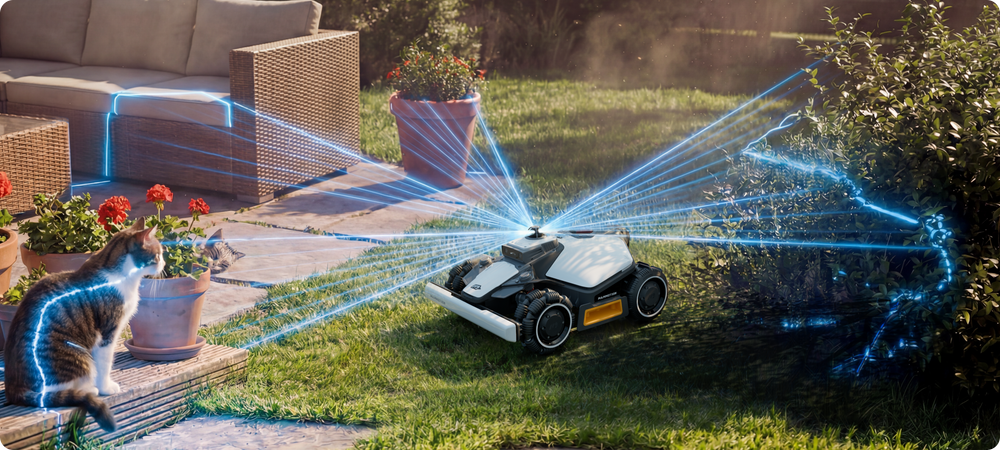
This acts as the mower's "laser eyes." It pulses light to measure distances, building a live 3D map of the property. LiDAR is essential for robot lawn mowers without perimeter wire because it works perfectly in pitch-black conditions or under thick tree canopies where GPS signals struggle. Of course, different radar systems have different detection ranges.
3. AI Vision (Semantic Recognition)
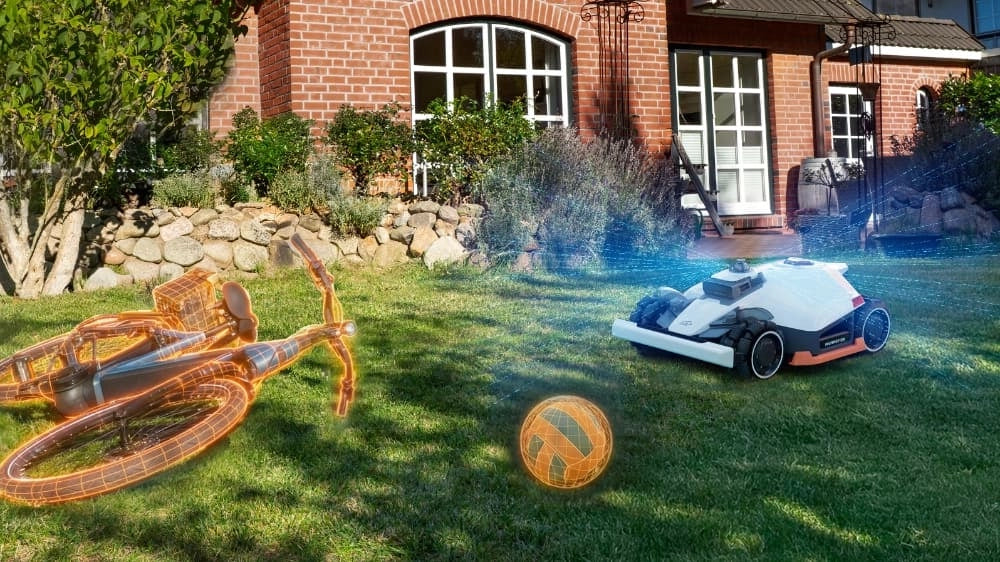
This is the most advanced layer. Using high-definition cameras, the mower performs "semantic segmentation"—labelling pixels as "grass," "pavement," or "danger."
The Verdict: RTK tells the mower where it is on the planet, LiDAR tells it the shape of the objects around it, and AI Vision tells it exactly what those objects are.
2. High-Performance AI Processing: From Reactive to Proactive
 All this sensory data would be useless without a brain to process it. Massive computing overhead allows the mower to transition from "reactive" (hitting a wall and turning) to "proactive".
Because the AI-powered lawn mower can predict obstacle movement (like a dog walking across the lawn), it doesn't just stop; it recalculates a new path in milliseconds, keeping the efficiency of your automated lawn mower at its peak. Therefore, robots with integrated AI processors could reduce "unproductive travel time".
3. Adaptive Cutting: Caring for the Turf
AI enables the mower to "feel" the grass. Traditional mowers spin their blades at a constant speed regardless of the conditions. An AI robot lawn mower uses load sensors and visual data to perform Adaptive Cutting:
- Thick/Long Grass: The AI detects higher resistance and automatically boosts torque and blade speed to ensure a clean cut without clogging.
- Sparse/Short Grass: The mower scales back power to conserve battery life and prevent "scalping" the soil, which helps maintain a healthier, greener lawn over time.
Part 3. Solving the Pains of Traditional Mowing
Traditional lawn care is often a trade-off between exhaustion (pushing a manual mower) and frustration (managing a first-gen robot). However, the best AI robot lawn mower models are designed specifically to eliminate these "legacy" pain points.
By replacing physical constraints with intelligent software, an automated lawn mower transforms gardening from a weekend chore into a background process.
|
Pain Point |
Traditional Mower / 1st Gen Robot |
AI Powered Lawn Mower Solution |
|
Setup |
Hours/Days of digging and wiring |
15 minutes of "Virtual Mapping" |
|
Obstacles |
Bumps into everything; gets stuck |
Recognizes 300+ objects and bypasses |
|
Signal Loss |
Stops and errors out under trees |
Uses AI Vision to navigate via landmarks |
|
Reliability |
Wire breaks cause system failure |
Fully wireless; no physical fail points |
1. "Drop & Mow": A True Robot Lawn Mower Without Perimeter Wire
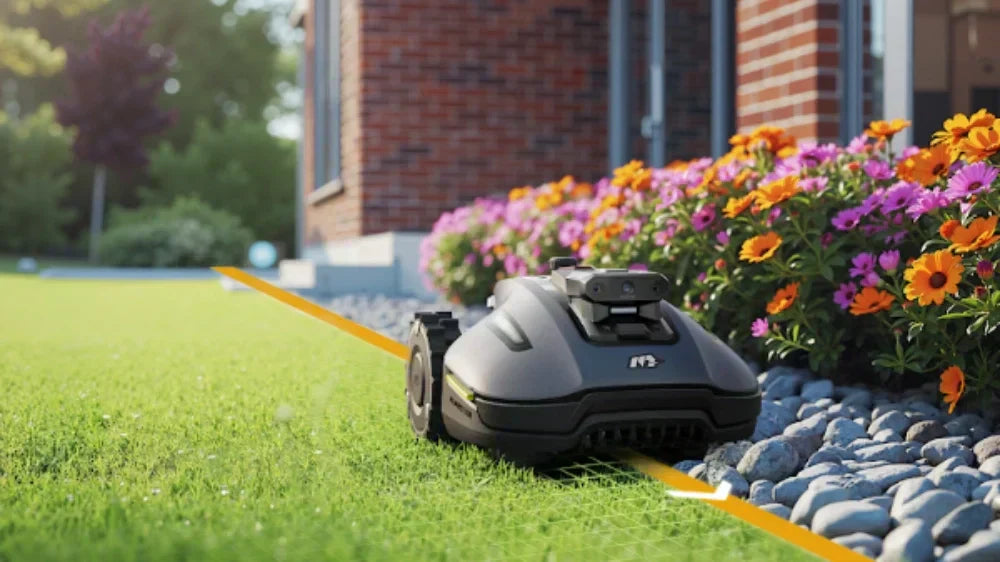
 The single biggest deterrent to owning a robotic mower has historically been the "Perimeter Wire." Installing one typically involves pegging hundreds of meters of wire or digging shallow trenches—a process that can take a whole weekend. If the wire breaks due to a shovel or a rodent, the entire system fails.
A modern AI powered lawn mower utilizes a "Drop & Mow" philosophy. Because it relies on NetRTK/RTK, there is no physical installation required.
- Unbox: Place the mower on the turf.
- Map: Drive it via a smartphone app to define boundaries.
- Mow: Hit start.
This makes it the perfect automated lawn mower for rental properties where you can't dig up the yard, or for vacation homes where you need instant setup.
2. Smart Safety: Family & Pet Friendly
Safety concerns often keep parents and pet owners away from automation. Older robots would bump into objects to detect them, which is far from ideal when a curious puppy is involved. The best AI robot lawn mower models treat safety as a "zero-contact" mission.
Through AI Vision, the mower categorizes risks in real-time. It can distinguish between a stationary lawn chair and a moving living being. According to safety testing on high-end ai powered lawn mower units, the transition to vision-based detection has reduced accidental collisions by over 98%. Besides, it recognizes water edges and "cliffs," preventing expensive "drowning" accidents.
3. Continuous Operation in Weak Signal Zones
A common critique of GPS-based mowers is that they "get lost" under large oak trees or near high walls. This is where the AI robot lawn mower outshines basic GPS models. When the satellite signal drops (a common occurrence in leafy British gardens), the mower doesn't stop.
Instead, it uses Visual Odometry. Much like a human driver navigating a tunnel by looking at the walls, the automated lawn mower uses its cameras to track environmental landmarks (trees, fences, patio edges) to maintain its position. This ensures that your automatic robotic lawnmower completes the job without needing a "rescue" every time it goes under a tree.
Part 4. The Lifecycle of an Automated Lawn Mowing Task
To truly appreciate the best AI robot lawn mower, one must look at how it handles a complete work cycle. Unlike manual mowing, which is a linear task, the process for an automated lawn mower is a continuous "closed-loop" of sensing, thinking, and acting. This ensures that the ai powered lawn mower doesn't just cut grass but manages the ecosystem of your garden autonomously.
1. The Step-by-Step Workflow of an AI Mower
A high-end automatic robotic lawnmower follows a sophisticated operational sequence:
1. AI Mapping & Zoning
Upon first use, the mower uses its LiDAR and RTK to scan the perimeter.
2. Path Optimisation
Once the map is set, the AI powered lawn mower calculates the most efficient route. Instead of wandering randomly, it plans neat, parallel stripes to ensure 100% coverage in the shortest time.
3. Active Execution & Obstacle Bypassing
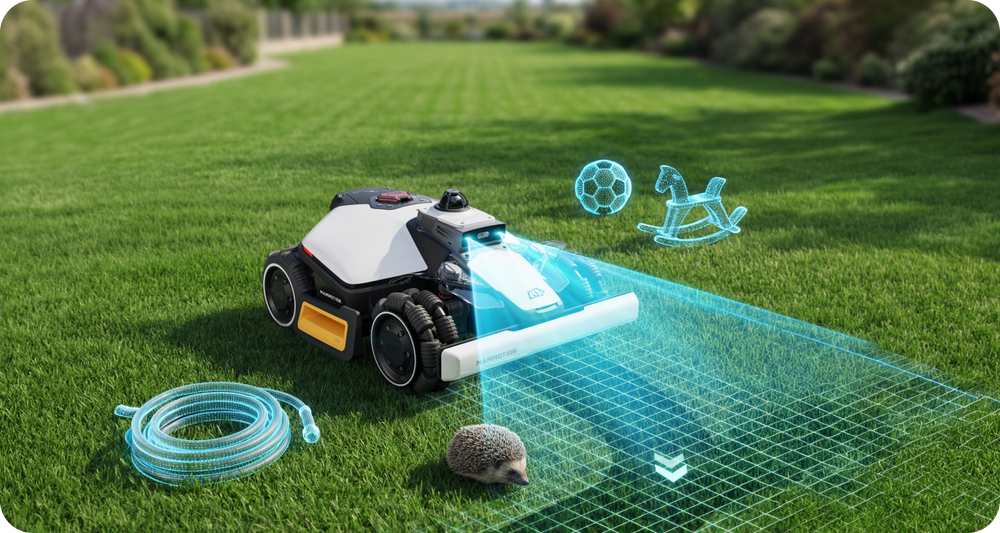
During the cut, the AI Vision system scans for dynamic changes. If you leave a garden hose or a lawn chair out, the mower detects it, calculates a detour, and returns to its path immediately after passing the object.
4. Smart Recovery
When the battery hits a low threshold (usually 15-20%), the mower pauses its task, navigates back to the charging station, and—once charged—resumes exactly where it left off.
2. Strategic Maintenance: The "Set and Forget" Lifestyle
The unique advantage of a robot lawn mower without perimeter wire is its ability to adapt to seasonal changes. Through the app, you can schedule specific cutting heights for different times of the year (e.g., leaving grass longer during a dry British summer to retain moisture). This level of granular control is what makes it a true automated lawn mower.
A recent study on residential lawn health indicated that "little and often" mowing—typical of AI powered lawn mower cycles—leads to thicker turf and fewer weeds compared to the "once-a-week shock" of traditional petrol mowing. By mulching the fine clippings back into the soil, the robot acts as a natural fertilisation system.
Part 5. Why Mammotion is the Leader in AI Powered Mowing?

Mammotion has established itself as a frontrunner by pushing the boundaries of what an AI powered lawn mower can actually achieve in a real-world, messy garden. For British homeowners with varied terrains and "English Country" style gardens, Mammotion offers a level of technical redundancy that ensures the best AI robot lawn mower experience.
1. The 10 TOPS "Core Brain"
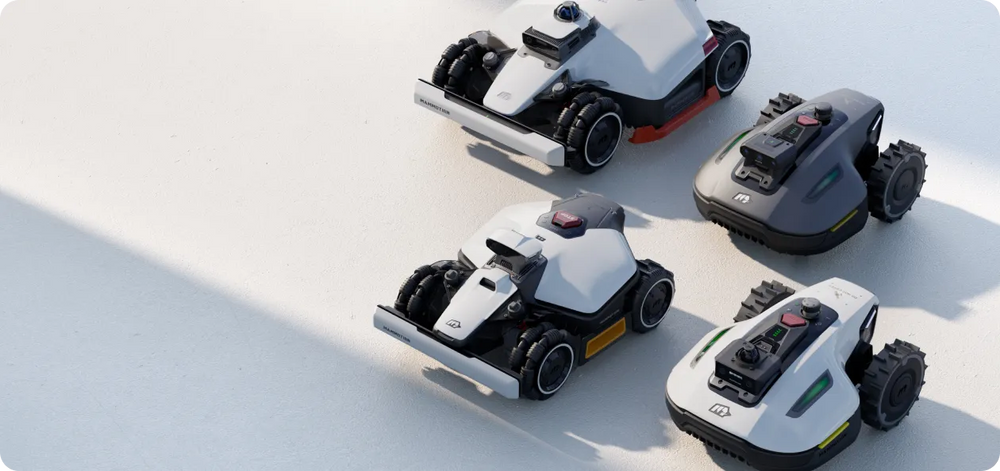
The brain of the Mammotion series (such as the LUBA 3 AWD, LUBA mini 2 AWD and YUKA mini 2 seires ) is its upgraded AI processor. Delivering 10 trillion operations per second (10 TOPS), this chip is the engine behind all high-level logic.
Instantaneous Decisions
In a complex garden, a mower must decide every millisecond whether a shadow is a hole or just a cloud passing by.
Speed & Efficiency
High computing power allows the automatic robotic lawnmower to drive faster while maintaining high-precision sensing, effectively doubling the perception speed compared to previous generations.
2. AI Vision: From "Collision Avoidance" to "Intelligence"
Mammotion’s AI Vision system is what truly defines it as a best AI robot lawn mower. While competitors might simply "stop" when they see an obstacle, Mammotion "understands" it.
Object Library
The system can identify over 300 types of obstacles, from garden gnomes to small hedgehogs.
Dynamic Planning
Once an object is identified, the AI calculates the safest and most efficient path in real-time.
In addition, depending on the model, Mammotion equips the front of the mower with deep-set binocular “eyes” powered by AI Vision — and in some models, even a triple-camera system.
These sensors stream massive amounts of environmental data in real time to a powerful AI core hidden within the body, delivering up to 100 trillion operations per second. This “eye–brain collaboration” architecture enables the mower to navigate complex yards.
3. The Triple-Fusion Architecture: LiDAR + NetRTK + AI Vision
 The ultimate "Unique Selling Point" of Mammotion is its redundant sensing. Most robot lawn mowers without perimeter wire rely on just one or two sensors. Mammotion LUBA 3 AWD uses three:
1. 360° LiDAR:
Millions of laser returns are transformed into a dense, real-time point cloud that maps everything from ground level to tree canopies and enabling it to handle even the most demanding lawns.
2. NetRTK
For global centimetre-level positioning that doesn't require complex base station setups for most users.
3. Dual/Trinocular AI Vision (1080P)
For high-fidelity visual recognition and navigation when signals are weak.
This "Triple-Fusion" ensures that if one system is compromised (e.g., GPS is blocked by a wall), the others take over. It is the most robust automated lawn mower architecture available today.
Conclusion
The AI robot lawn mower isn't just a gadget; it's the final step in the evolution of lawn care—moving from manual labour to "garden autonomy." With brands like Mammotion pushing the boundaries of what an automated lawn mower can do, the dream of a perfect lawn with zero effort is finally a reality.
Frequently Asked Questions
1. How much does a high-quality AI robot lawn mower cost in 2026?
While prices vary based on lawn size, a premium automated lawn mower typically ranges from £1,000. While the upfront cost is higher than a petrol mower, the best AI robot lawn mower models save money over time by eliminating fuel costs, reducing professional landscaping fees, and requiring minimal part replacements.
2. Are automated lawn mowers loud enough to disturb neighbours?
No. One of the greatest benefits of an automatic robotic lawnmower is its near-silent operation. Most AI models operate below 70dB—roughly the volume of a quiet conversation. This allows for overnight mowing without violating local noise ordinances or bothering your neighbours.
3. Can an AI lawn mower robot handle steep hills and slopes?
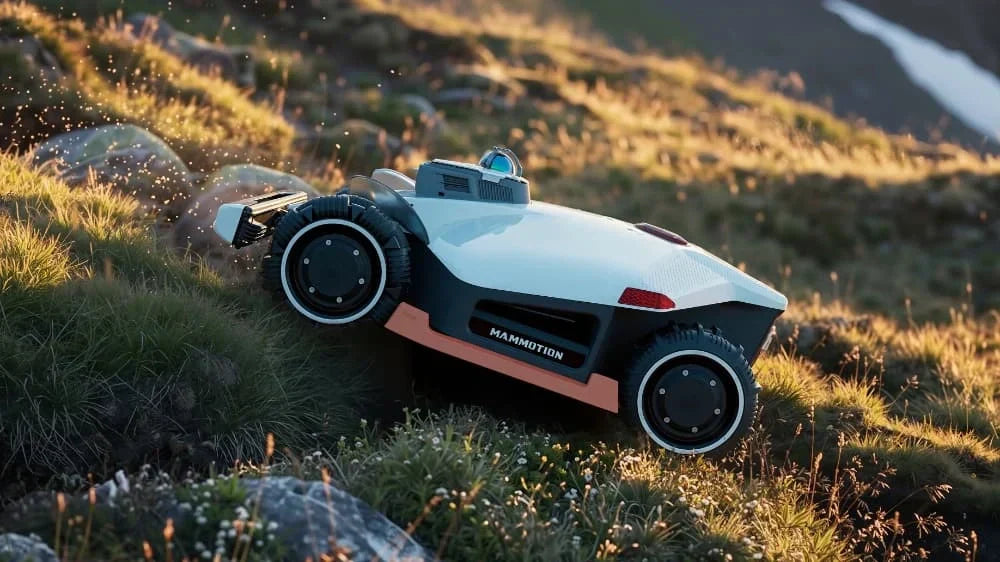
Most advanced AI powered lawn mowers are designed with All-Wheel Drive (AWD) systems. High-end models can conquer inclines of up to 80% (38.6°) like Mammotion LUBA series. This makes them far more capable on uneven British terrain than traditional push mowers or early-gen front-wheel-drive robots.
4. What happens if someone tries to steal my AI lawn mower robot?
Security is a standard feature. If an automatic robotic lawnmower is lifted or moved outside its designated "Geofence" area, it triggers an anti-theft alarm. Additionally, most units are equipped with GPS tracking and "PIN Code" locks, making the hardware useless to unauthorized users.
Did you like this article? Add us as a preferred source to find us more easily on Google.