







If you’ve been wondering how to level a lawn effectively, you aren't alone. In the UK, our unique soil compositions (from heavy clay to sandy loams) mean that lawn levelling isn't a one-size-fits-all job. Achieving a level lawn result requires a bit of patience and the right technique, but the payoff is a safer, more beautiful space that is much easier to maintain.
This guide will walk you through the professional secrets of how to flatten a lawn and how to keep a smooth lawn with Mammotion robot lawn mowers, ensuring your grass stays healthy and your weekends remain stress-free.
Part 1. Why Lawn Levelling Matters?
Professional lawn levelling is essential because an uneven surface is the primary cause of "scalping"—where your mower blades cut too low on high spots, leaving unsightly brown patches. Beyond aesthetics, a level grass lawn ensures uniform water distribution, preventing the stagnant puddles that invite moss and root rot, which are common headaches in damp British climates.
- Prevents Mowing Difficulties: Bumps cause the mower to bounce, leading to an uneven cut and potential blade damage.
- Eliminates Water Pooling: Low spots collect rainwater, drowning the grass and creating muddy bogs.
- Safety for the Family: A flat surface removes trip hazards for children playing football or elderly relatives walking in the garden.
- Improved Nutrient Absorption: Fertilisers and treatments settle evenly rather than washing into the "valleys" of your turf.
Part 2. What Causes an Uneven Lawn?
Most lawns become uneven due to a combination of natural soil movement and external pressure. In many UK regions, heavy clay soil is the culprit; it expands when wet and shrinks during summer dry spells, creating a "wavy" effect. Understanding the root cause is the first step in learning how to level grass effectively for the long term.
Soil Settling
Newly built homes often suffer from "settlement" where the ground beneath the turf shifts over the first few years.
Wildlife Activity
British gardens are hotspots for moles, foxes, and even worms (casting), which displace soil and create voids.
Heavy Foot Traffic
Constant walking, pet activity, or heavy garden furniture can compact soil in specific paths.
Tree Roots
Large, established trees can push through the surface or suck moisture unevenly from the ground.
Drainage Problems
Subsurface water flow can wash away soil particles, leading to invisible hollows that eventually collapse.
Poor Initial Installation
If the garden wasn't cleared of debris or raked properly before the turf was laid, bumps are inevitable.
Part 3. Signs You Need to Level the Grass Lawn
You can identify the need for a level grass lawn through several "warning signs" that appear during routine maintenance. The most obvious indicator is scalping, where your mower blades hit a high spot and cut the grass down to the soil, leaving a brown patch. Conversely, if you notice "micro-wetlands" or moss concentrated in specific sunken areas after a typical British downpour, these are clear signs of drainage issues caused by an uneven surface.
Part 4. When Is the Best Time to Level a Lawn?
The optimal window for lawn levelling in the UK is mid-to-late spring (April to May) or early autumn (September). During these periods, the soil is moist enough to work with, but more importantly, the grass is in its peak growth phase. This ensures that when you apply a top-dressing or disturb the root system, the turf has the vitality to grow through the new soil and recover quickly.
|
Season |
Suitability |
Reason |
|
Spring |
Excellent |
Rapid growth helps grass recover from being covered by a soil/sand mix. |
|
Summer |
Poor |
High temperatures and potential drought stress make it hard for grass to survive "top-dressing." |
|
Autumn |
Good |
Warm soil and frequent rain aid recovery, though growth slows as winter approaches. |
|
Winter |
Avoid |
Grass is dormant; wet soil becomes "puddled" and compacted if worked. |
Part 4. Tools and Materials Needed for Lawn Levelling

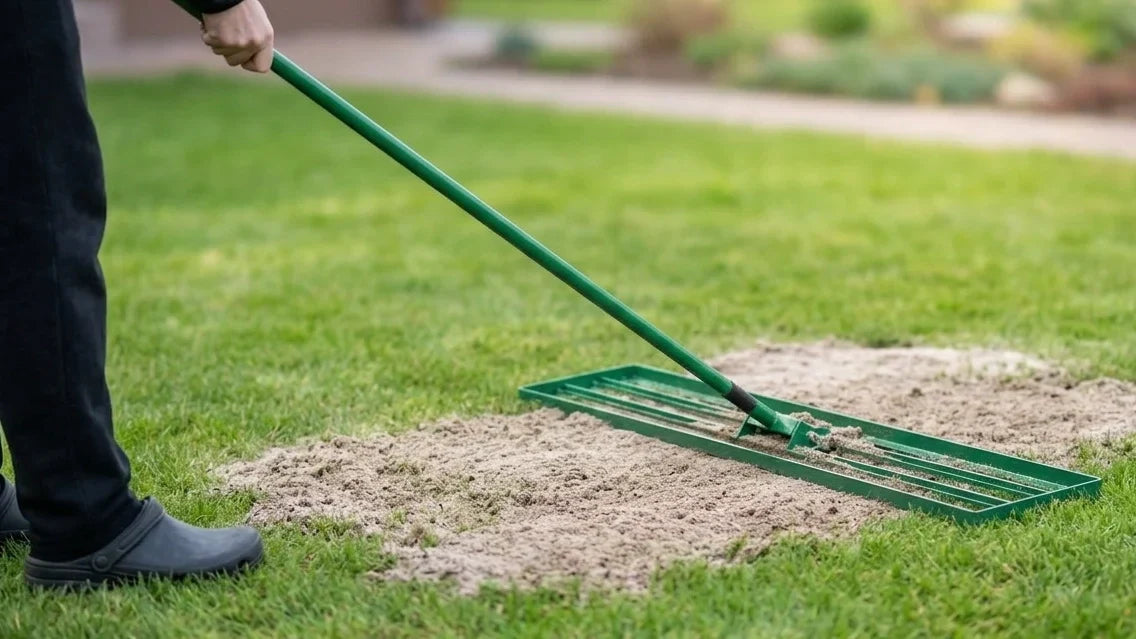
To achieve a professional finish, you need a mix of standard garden essentials and a few specialised items. While a standard garden rake can suffice for small patches, a dedicated lawn levelling rake (also known as a lute) is the secret to a perfectly flat surface. Using a rake level across the soil ensures that the dressing mix fills only the voids without burying the healthy grass.
|
Tool |
Purpose |
Necessity |
|
Garden Rake |
Removing debris and scarifying the surface. |
Essential |
|
Wheelbarrow |
Mixing and transporting the top-dressing. |
Essential |
|
Spade |
Lifting turf for deep "hollow" repairs. |
Essential |
|
Lawn Levelling Rake |
Spreading the mix evenly across the lawn. |
Highly Recommended |
|
Light Lawn Roller |
Gently settling the soil after repair. |
Optional |
|
Levelling Mix |
A blend of sharp sand and topsoil (70/30 ratio). |
Essential |
In addition to these, don't forget your PPE: gloves to prevent blisters from the rake level work and safety glasses if you are handling dry, sandy mixes on a windy day. For those aiming for perfection, a laser level can help map out the high and low points of a larger garden.
Part 5. How to Level a Lawn:Step-by-Step Guide
The process of how to level a lawn involves preparation, precise filling, and patient aftercare. If you follow these steps, you can transform a bumpy patch into a level grass lawn that is ready for a high-performance mower.
1. Mow the lawn
- Set your mower to one of its lowest settings.
- Cut the grass shorter than usual so you can clearly see the soil surface.
- Using a robotic mower is actually the most efficient way to prepare your grass for lawn levelling. Unlike traditional petrol mowers that can be heavy and difficult to manoeuvre over bumps, Mammotion Robotic lawn mowers use precision cutting decks that can be adjusted incrementally via an app. This allows you to safely bring the grass height down to a level where the soil becomes visible, providing a clear "map" of the dips and hollows that need addressing without the risk of manual "scalping."
2. Identify dips
- Walk the garden and look for "low spots" or hollows.
- Use a long straight edge or a string line to identify exactly where the ground falls away.
- Mark these areas with garden-safe spray paint or small stakes.
3. Prepare levelling mix
- In your wheelbarrow, create a custom mix. For most UK gardens with clay soil, a ratio of 2 parts sharp sand to 1 part topsoil is ideal.
- Ensure the mix is dry; wet soil is difficult to spread and will clump.
This is the best way to level a garden because the sand provides drainage while the soil provides nutrients.
4. Fill low spots
- For shallow dips (under 2cm), sprinkle the mix directly onto the grass.
- Use your rake level or the back of a garden rake to spread the mix until it fills the hole.
- Ensure at least the tips of the grass blades are still visible so they can continue to photosynthesise.
5. Fix deep depressions
- For ruts deeper than 3cm, use a spade to cut an 'X' shape into the turf.
- Peel back the grass "flaps" carefully.
- Fill the void underneath with your mix and tread it down firmly.
- Fold the turf back over, ensuring it is now level the lawn surface, and press it into place.
6. Water and settle
- Use a fine mist setting on your hose to water the area.
- This helps the mix settle into the gaps between the grass blades.
- Avoid heavy jets of water, which can wash your hard work away.
Part 6. Lawn Levelling vs Lawn Rolling?
A common misconception in UK gardening is that a heavy water-filled roller is the fastest way to flatten a lawn. While rolling is useful for pressing down newly laid turf to ensure root-to-soil contact, it is rarely the solution for an established, bumpy lawn. In fact, over-rolling can be "lawn suicide" for the heavy clay soils found in many British regions, leading to severe compaction that suffocates grass roots.
|
Feature |
Lawn Levelling (Top Dressing) |
Lawn Rolling |
|
Method |
Adding material to fill the gaps. |
Using weight to compress the peaks. |
|
Soil Health |
Improves drainage and adds nutrients. |
Increases compaction and reduces oxygen. |
|
Best For |
Fixing dips, holes, and general unevenness. |
Settling new turf or frost-heaved soil. |
|
Long-term Result |
A permanent, healthy level grass lawn. |
Temporary flatness with potential drainage issues. |
Part 7. How to Maintain a Smooth Lawn?

Once you’ve achieved that elusive level of grass lawn, the goal is prevention. A smooth surface is a living thing that requires consistent "little and often" care to prevent soil shifting or thatch buildup.
1. Regular Mowing with Robot Lawn Mower
The secret to a pristine surface is frequent cutting. Mammotion Robotic lawn mowers are designed to traverse your garden daily. Because they are significantly lighter than traditional petrol mowers, they don't create "ruts" or soil compaction over time. Their All-Wheel Drive (AWD) ensures they glide over the terrain without digging in, keeping the grass blades uniform and the surface undisturbed.
2. Aeration
Use a hollow-tine aerator every autumn. This relieves pressure within the soil, preventing the "heaving" that causes bumps.
3. Annual Top-Dressing
Even a healthy lawn benefits from a light "maintenance" lawn levelling every spring. A thin 5mm layer of sand-soil mix keeps the surface "table-top" smooth.
Part 8: Can Robotic Lawn Mowers Handle Uneven Lawns?
While you don’t need a lawn as flat as a bowling green, lawn levelling significantly enhances the efficiency and lifespan of your robotic helper. Most standard robot mowers struggle with traction on bumpy terrain, but Mammotion Robotic lawn mowers are specifically engineered with All-Wheel Drive (AWD) and high-clearance decks to navigate typical garden undulations. However, taking the time to level the lawn ensures that the cutting height remains consistent across the entire garden, preventing the blades from scalping high spots or missing grass in deep ruts.
Traction and Stability
Mammotion's LUBA series, especially the newly released LUBA 3 AWD. For instance, it can climb slopes up to 80% (38°) so that it handles bumps better than most, while a level grass lawn reduces the physical strain on the motor and suspension.
Precision Navigation
Using RTK, AI Vision and Lidar, these mowers map your garden with centimetre-level accuracy. A flatter surface ensures the sensors have a clear line of sight and aren't tilted at awkward angles by deep holes.
Uniform Aesthetic
A robot mower maintains a "just-cut" look every day. If the ground is uneven, that precision actually highlights the bumps
Conclusion
Levelling the grass lawn transforms a patchy, trip-prone space into a safe, lush, and high-performing landscape. Whether you are using a simple rake level to fix minor dips or performing a deeper "lift and fill" operation for significant ruts, the key is patience and timing.
With your lawn smoothed and a Mammotion robotic mower handling the daily trim, you can finally stop working on your garden and start truly enjoying it.
FAQs
1. How much does it cost to level a lawn in the UK?
For a DIY approach using a rake level and a standard sand-soil mix, you can expect to pay between £50 and £150 for materials, depending on the size of your garden. Professional lawn levelling services typically charge between £10 and £20 per square metre.
2. Can I use just sand to level my lawn?
It is not recommended to use only sand, especially on UK clay soils, as it can create a "concrete" effect when it dries. The best way to level a garden is using a 70/30 or 60/40 mix of sharp sand and high-quality topsoil to ensure nutrients reach the roots.
3. How long after levelling can I walk on the grass?
You should avoid heavy foot traffic for at least 2 to 3 weeks. This allows the grass to grow through the new top-dressing and ensures the soil has settled properly.
Did you like this article? Add us as a preferred source to find us more easily on Google.